
Search News
Industry Portal
Popular Tags
CNC control upgrades that fix repeatability without replacing machines
Author
Dr. Isaac Logic
Time
May 06, 2026
Pageviews
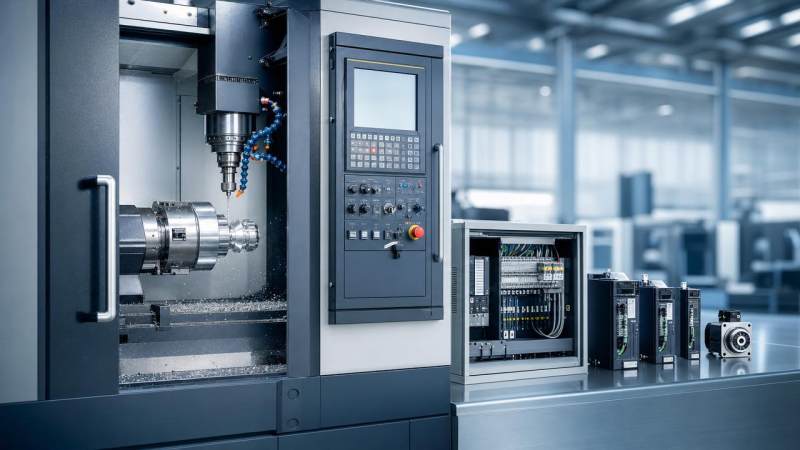
When repeatability drifts, replacing an entire machine is not always the smartest investment. A targeted CNC control upgrade can restore positioning consistency, reduce scrap, and extend equipment life without major capital disruption. For technical evaluators, understanding which CNC control improvements deliver measurable gains is essential to balancing retrofit risk, production stability, and long-term automation performance.
Why a checklist-based CNC control evaluation works better than a generic retrofit discussion
For most factories, repeatability problems do not come from one isolated failure. They usually emerge from a chain of small issues: outdated servo response, encoder feedback noise, interpolation limits, thermal drift compensation gaps, worn transmission elements, or unstable PLC-to-motion coordination. That is why a checklist approach is more useful than a broad conversation about modernization. Technical evaluators need to separate control-related losses from mechanical wear, define measurable upgrade targets, and identify which CNC control changes can improve consistency without creating integration risk.
In smart manufacturing environments, especially where legacy assets still carry production load, the right retrofit decision depends on verifiable engineering logic. A disciplined review helps teams compare controller capability, motion quality, communication architecture, compliance expectations, and life-cycle support. This is especially relevant to organizations following benchmark-driven selection practices such as those promoted by data-focused engineering platforms like G-IFA, where hardware precision and software intelligence must be evaluated together.
Start here: the first five checks before approving any CNC control upgrade
- Confirm the repeatability symptom with data. Compare commanded position versus actual position, part-to-part dimensional spread, thermal behavior by shift, and scrap records. If the problem is not quantified, the CNC control upgrade scope will likely be wrong.
- Separate control limitations from mechanical degradation. Backlash, ballscrew wear, guideway looseness, spindle vibration, and fixture instability can mimic poor control performance. A new CNC control cannot fully correct a machine that has lost structural integrity.
- Check current control architecture. Identify the installed CNC, servo drives, motor types, feedback devices, fieldbus protocol, PLC connection, HMI, and any proprietary machine builder logic that may complicate retrofit compatibility.
- Define the production objective. Is the goal tighter repeatability, faster cycle time, better contouring, easier diagnostics, or reduced downtime? A CNC control upgrade should be justified by a specific operational outcome, not just by age.
- Assess downtime tolerance. Some upgrades are straightforward controller swaps; others require servo tuning, rewiring, parameter recreation, and validation runs. The acceptable outage window often determines the feasible retrofit strategy.
Core CNC control upgrade checklist: what technical evaluators should inspect
The following checklist focuses on the components and functions most likely to improve repeatability without requiring a full machine replacement. Each item should be reviewed against current machine condition, production mix, and integration constraints.
1. Servo and feedback performance
- Verify whether the existing servo drives support higher-resolution encoder feedback, better loop update rates, and improved disturbance rejection.
- Check for drift caused by analog interfaces or aging feedback devices. Digital feedback and modern servo diagnostics can significantly improve repeatability.
- Review axis tuning stability under load changes, especially on machines with frequent acceleration and deceleration cycles.
2. Interpolation and motion kernel quality
- Determine whether the CNC control supports smoother contouring, look-ahead processing, jerk limitation, and better corner transition handling.
- For multi-axis machining, assess synchronization precision and dynamic path correction features.
- If repeatability losses appear mainly on complex profiles rather than simple point-to-point moves, interpolation quality is a key upgrade candidate.
3. Compensation functions that reduce hidden variation
- Look for backlash compensation, pitch error compensation, thermal compensation, and spindle growth correction capabilities.
- Check whether the machine has the sensors and calibration process needed to make compensation effective.
- A modern CNC control can improve consistency substantially, but only if compensation tables are maintained and based on real measurements.
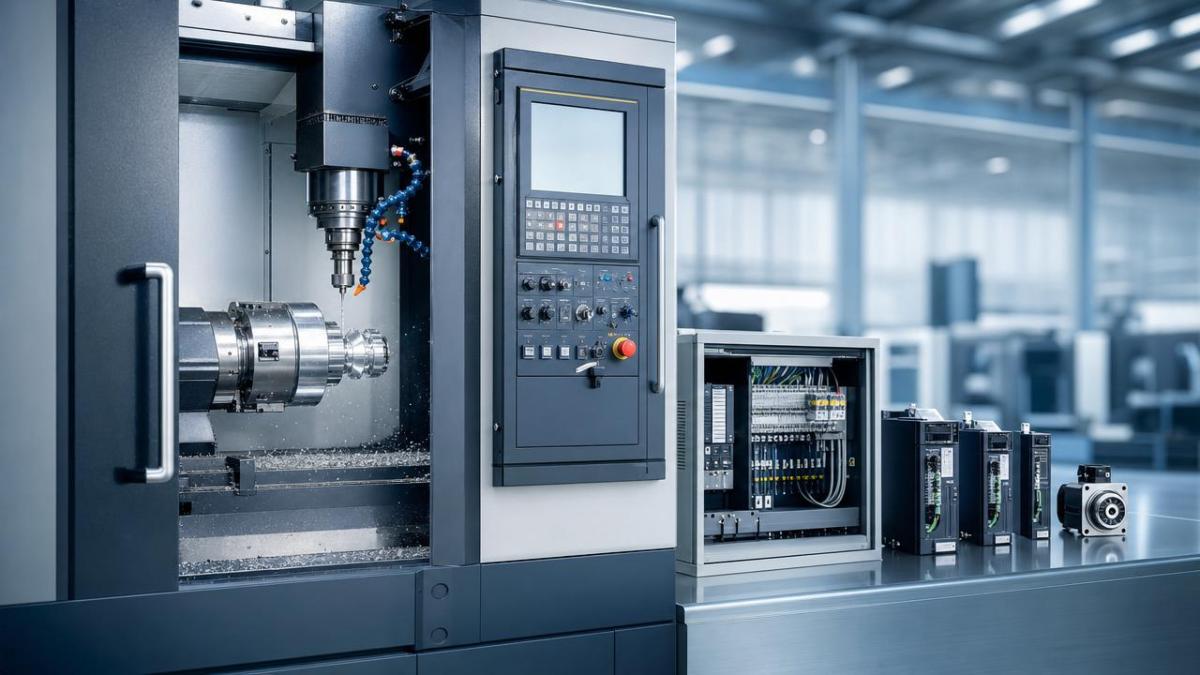
4. PLC and machine logic integration
- Inspect how the CNC control exchanges signals with hydraulic, pneumatic, spindle, tool changer, lubrication, and safety functions.
- Confirm whether ladder logic or PLC routines can be migrated cleanly, or whether machine builder support is required.
- Poorly managed integration can erase the repeatability gains of a new controller by introducing sequence timing errors.
5. Communications, diagnostics, and software visibility
- Prioritize CNC control platforms with accessible alarm history, servo trace tools, maintenance logs, and network connectivity to MES, ERP, or plant monitoring systems.
- Repeatability issues are easier to solve when the control provides high-quality data rather than only fault codes.
- For Industry 4.0 environments, open communication and diagnostics reduce future risk and improve lifecycle value.
How to judge whether the machine is a good candidate for CNC control modernization
Not every machine deserves a retrofit. Technical evaluators should screen candidates using practical criteria rather than relying on age alone. A machine is usually a strong CNC control upgrade candidate when its frame, guideways, spindle system, and core mechanics remain serviceable; when the machine still fits production needs; and when repeatability losses are linked to control response, feedback quality, or unsupported legacy electronics.
By contrast, if the machine suffers from severe geometric error, unstable thermal structure, poor spindle health, or chronic maintenance gaps, investing in a new CNC control may only delay replacement. In other words, modernization works best when the control is the bottleneck, not when the entire machine tool has reached the end of its useful mechanical life.
Scenario-based guidance: what changes by machine type and production need
High-mix, low-volume machining
For shops with frequent program changes, setup variation often amplifies repeatability concerns. Here, a CNC control upgrade should prioritize better HMI usability, stronger program management, improved probing integration, and clearer diagnostics. The value is not only in axis precision but also in reducing setup-induced inconsistency.
Stable, repetitive production lines
When the same parts run continuously, small positioning errors create cumulative scrap and hidden cost. In this case, focus on servo stability, thermal compensation, closed-loop control quality, and preventive diagnostics. A CNC control with stronger traceability and condition visibility can support statistical process control more effectively.
Multi-axis contouring applications
If the machine produces complex surfaces or coordinated motion paths, the upgrade decision should emphasize interpolation algorithms, look-ahead, dynamic compensation, and synchronized motion performance. Repeatability in these applications is often affected more by motion quality than by static positioning accuracy alone.
Plants integrating broader automation systems
Where machines feed robotic loading cells, traceability platforms, or centralized production software, CNC control selection should also consider protocol support, cybersecurity posture, alarm standardization, and data accessibility. A controller that improves repeatability but remains digitally isolated may limit future automation gains.
Commonly overlooked risks that can weaken CNC control upgrade results
- Parameter migration errors: Legacy offsets, gain values, compensation tables, and machine-specific sequences are often poorly documented.
- Encoder and motor mismatch: A new CNC control may require compatible feedback standards or drive interfaces that legacy motors cannot support.
- Underestimating commissioning time: Tuning and validation can take longer than hardware replacement, especially on customized machines.
- Ignoring operator transition: Better control performance is undermined if operators and maintenance teams cannot use new functions correctly.
- Skipping metrology verification: Repeatability improvements should be confirmed by ballbar testing, laser calibration, part studies, or equivalent validation methods.
A practical execution plan for evaluating and implementing the upgrade
A disciplined execution path reduces retrofit uncertainty. First, capture baseline data: current repeatability, scrap rates, downtime frequency, cycle time stability, and maintenance history. Second, create a machine architecture map that documents controller version, drives, motors, I/O, PLC dependencies, and connected automation subsystems. Third, request a gap analysis from qualified suppliers or integrators, focusing on which CNC control functions directly address the observed performance losses.
Next, compare at least three dimensions of value: expected repeatability gain, implementation risk, and future digital integration benefit. This is where benchmark-oriented evaluation is useful. Technical teams should not judge a CNC control only by brand familiarity; they should review support depth, spare parts continuity, standards alignment, and integration openness. Finally, define acceptance criteria before commissioning begins. Without pre-agreed success metrics, upgrade discussions often become subjective.
Minimum data package to prepare before talking to retrofit partners
- Machine make, model, axis configuration, and year of build
- Existing CNC control model, drive system, and motor/encoder details
- Part tolerance requirements and repeatability failure patterns
- Alarm logs, maintenance records, and downtime statistics
- Network, PLC, HMI, and production software integration needs
- Acceptable outage window, budget range, and validation expectations
FAQ for technical evaluators reviewing CNC control options
Can a CNC control upgrade solve repeatability by itself?
Only when control limitations are the main cause. If mechanical wear, fixturing problems, or thermal instability dominate, the upgrade must be paired with corrective maintenance or calibration.
What is the biggest sign that the existing CNC control is the bottleneck?
A strong sign is when the machine structure remains sound, but servo instability, limited compensation, obsolete feedback technology, or poor diagnostics prevent stable precision over time.
Should the upgrade include drives and feedback devices, or only the controller?
In many cases, the best result comes from a matched CNC control, drive, and feedback package. Reusing incompatible legacy elements can reduce the achievable precision benefit.
Final decision guide: what to confirm before moving forward
Before approving any CNC control project, confirm six points: the repeatability problem is measured; the machine is mechanically worth saving; the upgrade target is clearly tied to production value; controller compatibility risks are known; commissioning resources are realistic; and acceptance criteria are documented. This checklist-based approach helps technical evaluators avoid both over-retrofitting and premature replacement.
If your team needs to assess parameters, retrofit scope, standards alignment, digital integration, timing, or budget fit, the most productive next step is to prepare a structured machine data package and discuss it with a qualified control supplier, system integrator, or engineering benchmark resource. A well-scoped CNC control upgrade can often restore repeatability, protect existing assets, and create a more reliable path toward broader factory automation.
Recommended News
- 2026/10/24Car Spare Parts: How to Check Fitment and Avoid Ordering the Wrong PartOrder car spare parts with confidence. Learn how to verify VINs, OEM numbers, and fitment details to avoid costly mistakes and choose the right replacement first time.
- 2026/10/23How Do You Select a Motion Control System for Synchronized Axes?How do I select a motion control system for synchronized axes? Discover key timing, feedback, and performance checks to choose confidently and reduce costly integration risks.
- 2026/10/23Integrating End-of-Line Sortation with Packing Stations and Conveyor ControlsOptimize end of line sortation with coordinated packing stations and conveyor controls. Learn how to prevent bottlenecks, improve routing accuracy, and handle exceptions reliably.