
Search News
Industry Portal
Popular Tags
How Do You Avoid Interface Conflicts During System Integration?
Author
Dr. Isaac Logic
Time
Oct 17, 2026
Pageviews
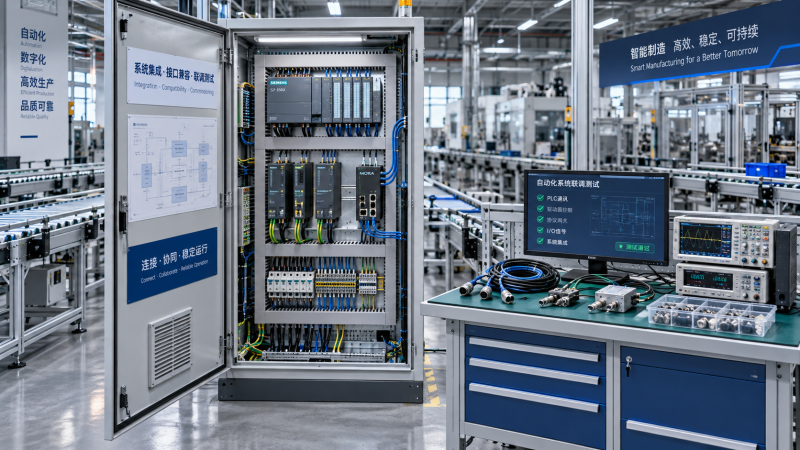
To avoid interface conflicts during system integration, define how connected systems must behave before selecting adapters, writing drivers, or commissioning equipment. A shared protocol is only the starting point. Robots, PLCs, drives, and manufacturing software also need compatible electrical characteristics, consistent data meanings, clear command ownership, and agreed responses when communication fails.
The strongest approach combines an interface contract, an appropriate connection architecture, and staged testing against measurable acceptance criteria. The balance depends on the application: a PLC-to-drive connection needs close attention to timing and fault response, while an MES-to-ERP interface needs reliable transaction handling and consistent business data. Applying the same integration method to both can create avoidable complexity or leave critical gaps.
Start with the conflicts that compatibility claims do not resolve
“Supports the same protocol” is useful for screening equipment, but it does not establish that two systems will work together. Devices may support different services, profiles, firmware capabilities, or connection limits. Even when messages arrive correctly, the receiving system may interpret their contents differently.
Consider a PLC sending a production quantity to an MES. Both systems may accept an integer, yet one treats it as the cumulative count since startup and the other as the quantity completed for the current order. Communication appears healthy while production records become unreliable. Similar conflicts arise when a robot position uses a different coordinate frame or a drive expects speed in different units.
Before integration begins, examine four boundaries:
- Physical and electrical: connectors, pin assignments, voltage levels, signal types, grounding, mechanical clearances, and pneumatic or hydraulic supply conditions.
- Communication: protocol features, device roles, addressing, connection capacity, network configuration, and supported software versions.
- Meaning and timing: units, scaling, identifiers, timestamps, update rates, permissible data age, and command sequencing.
- Authority and recovery: which system owns each command, how completion is confirmed, and what happens after a timeout, restart, or interrupted transaction.
These boundaries should be checked against the exact equipment configuration. A product family’s compatibility statement may not apply to every controller option or firmware revision. For a retrofit, existing wiring, controller capacity, and undocumented logic deserve the same attention as the new equipment.
Compare interface contracts with protocol-only checks
A protocol check answers whether systems can exchange messages. An interface contract defines what those messages mean and what each participant must do. Protocol checks remain necessary, but a contract exposes the disagreements that otherwise emerge during commissioning.
The contract does not need to become a large specification for every connection. Its depth should follow the consequence of failure. A monitoring-only temperature feed may need a signal definition, timestamp, quality indicator, and update expectation. A robot start command requires a more complete description of prerequisites, acknowledgment, execution, completion, and fault handling.
Define behavior alongside the data
For each consequential signal or transaction, record its source, destination, data type, unit, valid range, update condition, and owner. Include what “unknown,” “invalid,” and “unavailable” mean. A zero value must not silently stand in for a failed measurement if zero is also a valid process reading.
Then define the operating sequence. For a PLC-to-robot interface, distinguish a request received from a request accepted, and an accepted request from a completed movement. Specify whether commands use pulses, maintained signals, or identifiers. Without those rules, a command may be missed between scans or executed again after a reconnection.
Recipe transfer needs similar discipline. Identify which system owns the approved recipe, how revisions are identified, and when the receiving controller may activate a new version. A successful file transfer does not establish that all required values were accepted or that the recipe is appropriate for the selected machine configuration.
Make timing an acceptance condition
“Real time” is too vague to guide integration. Define the maximum acceptable delay, variation in delivery time, and age of data for the specific function. A dashboard may tolerate delayed updates that would make a machine interlock or coordinated movement unreliable.
Separate fast control functions from production reporting when their timing requirements differ. Avoid making a time-critical machine sequence depend on an enterprise application response unless that dependency has been deliberately designed and validated.
Assign an owner on each side of the interface and one person responsible for resolving disagreements across the boundary. Otherwise, each team can complete its own implementation while leaving a shared assumption unresolved. Place the accepted contract under change control so firmware updates, renamed tags, and altered data types trigger a compatibility review.
Choose direct connections, gateways, or middleware by function
The connection architecture determines where translation occurs and how failures spread. Direct connections, protocol gateways, and software middleware can all work, but they address different problems. Adding a translation layer without identifying the conflict can move the uncertainty into a less visible component.
Direct integration: fewer components, tighter coupling
A direct connection can suit devices with compatible interfaces and stable operating requirements. It reduces the number of components that need configuration, maintenance, and troubleshooting. For machine control, it can also keep the communication path easier to evaluate.
The tradeoff is tighter coupling. Changes to one endpoint may require changes to the other, especially when application logic relies on a vendor-specific data layout. Before choosing direct integration, verify the required functions on the exact versions involved and decide how future changes will be handled.
This approach becomes harder to maintain when many applications independently read or write the same controller. Multiple direct connections can create competing commands, inconsistent interpretations, and connection-capacity problems. Define which clients may observe data and which may change machine behavior.
Protocol gateways: useful translation with defined limits
A gateway is useful when equipment must communicate across different supported protocols, particularly in a retrofit where replacing a functioning controller is difficult. It can provide a controlled mapping between the two sides and concentrate diagnostics in one place.
However, protocol conversion does not automatically reconcile application meaning. A gateway may correctly transfer a register while preserving an incorrect unit, stale value, or ambiguous status code. Its mapping must therefore follow the interface contract.
Check supported functions, update behavior, buffering, restart behavior, and diagnostic visibility. Determine whether values are retained after an upstream disconnection and how downstream equipment learns that they are stale. A retained value can look valid even though its source is unavailable.
Middleware: stronger transaction handling, more operational responsibility
Middleware can suit integrations involving multiple MES, ERP, historian, or analytics consumers. It can centralize transformations, route messages, manage schemas, and support buffering or replay where configured. That can reduce the number of custom connections maintained at each endpoint.
It also introduces responsibilities for availability, access control, versioning, queue management, and recovery. Delayed or replayed messages need explicit handling. Replaying a production record may be appropriate; replaying an old machine command can be dangerous.
Use middleware where its transaction and coordination functions address a defined requirement. Keep time-critical control within an architecture designed for that purpose. A gateway, middleware platform, or direct link should each have a clear failure response and an identifiable maintenance owner.
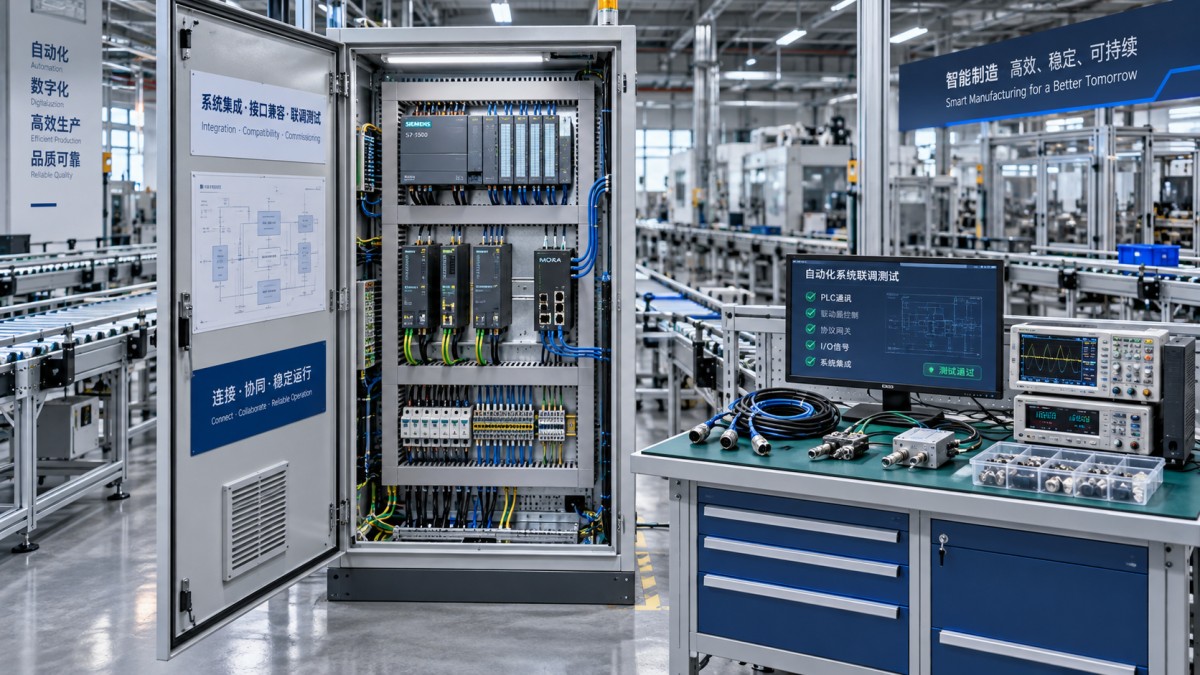
Test progressively, with failure recovery as a release condition
A single end-to-end test on the installed line makes conflicts difficult to isolate. If a production order fails to reach a machine, the cause could be a schema mismatch, permissions, a network issue, incorrect mapping, or controller state. Progressive testing narrows those possibilities before production is exposed.
Begin with document and configuration checks. Compare wiring drawings, mechanical interfaces, device descriptions, data maps, software versions, and network settings. Check duplicate addresses, port requirements, authentication methods, and available controller or gateway resources. For physical equipment, verify fit and utility requirements before installation.
Next, test each endpoint independently where practical. Simulators and test clients can establish whether a system accepts valid messages, rejects invalid ones, and reports errors clearly. They are useful for finding contract problems early, although they cannot fully reproduce real device timing, electrical conditions, or operating load.
Connect representative hardware in a controlled environment before full commissioning. Exercise the actual command sequence and verify results at both ends. Do not rely solely on a successful communication indicator: inspect the received values, resulting states, and application records.
Compare successful operation with interrupted operation
A normal cycle proves that the intended path can work. Recovery tests establish whether the system remains understandable when that path breaks. The test plan should cover conditions such as:
- A connection drops after a command is accepted but before completion is acknowledged.
- A controller or gateway restarts while another system remains online.
- The same transaction arrives more than once, or messages arrive out of sequence.
- A value is missing, outside its permitted range, or older than the allowed age.
- A downstream application is unavailable and queued messages accumulate.
For transaction interfaces, define how duplicates are recognized. Retrying a request after a timeout can create duplicate records if the first request succeeded but its acknowledgment was lost. Use transaction identifiers and duplicate handling where the receiving application supports them, and specify a reconciliation process where it does not.
For control interfaces, define the permitted machine response when communication becomes unreliable. The appropriate response depends on the process and risk assessment. It may involve inhibiting new starts, completing an allowed sequence, or transitioning to a defined state. Safety functions require their own suitable architecture and validation; ordinary communication health should not be treated as proof of safety performance.
Measure under representative load
A quiet bench test may hide conflicts that appear when reporting, diagnostics, recipe transfers, and normal control traffic operate together. Test the expected concurrent workload and examine controller scan behavior, communication delays, queue growth, and resource use. Compare the results with the interface’s agreed limits.
Record enough evidence to reconstruct failures: command identifiers, timestamps, state changes, error codes, and version information. Where cross-system event timing matters, establish appropriate clock synchronization. Otherwise, logs can suggest an incorrect sequence and send troubleshooting in the wrong direction.
Make handover preserve the compatibility you proved
Integration remains vulnerable if the working configuration cannot be reproduced or maintained. Handover should include the accepted interface contract, configuration backups, mappings, installed versions, test evidence, and a recovery procedure. Document who may change the interface and which changes require renewed testing.
Keep acceptance criteria tied to observable behavior: correct values, valid command sequences, acceptable response times, clear fault indication, and predictable recovery. “Communication established” is too narrow a release criterion for an interface that controls equipment or updates production records.
The next useful step is to review the highest-consequence boundaries in the planned system. For each one, identify any unresolved assumptions about meaning, timing, ownership, and recovery. Resolve those assumptions before commissioning. That gives engineers a concrete basis for choosing the connection method and gives production teams evidence that the interface will behave predictably when a normal operating cycle is interrupted.
Recommended News
- 2026/10/24Car Spare Parts: How to Check Fitment and Avoid Ordering the Wrong PartOrder car spare parts with confidence. Learn how to verify VINs, OEM numbers, and fitment details to avoid costly mistakes and choose the right replacement first time.
- 2026/10/23How Do You Select a Motion Control System for Synchronized Axes?How do I select a motion control system for synchronized axes? Discover key timing, feedback, and performance checks to choose confidently and reduce costly integration risks.
- 2026/10/23Integrating End-of-Line Sortation with Packing Stations and Conveyor ControlsOptimize end of line sortation with coordinated packing stations and conveyor controls. Learn how to prevent bottlenecks, improve routing accuracy, and handle exceptions reliably.