
Search News
Industry Portal
Popular Tags
What should be included in a fair control systems cost breakdown?
Author
Dr. Isaac Logic
Time
Apr 27, 2026
Pageviews
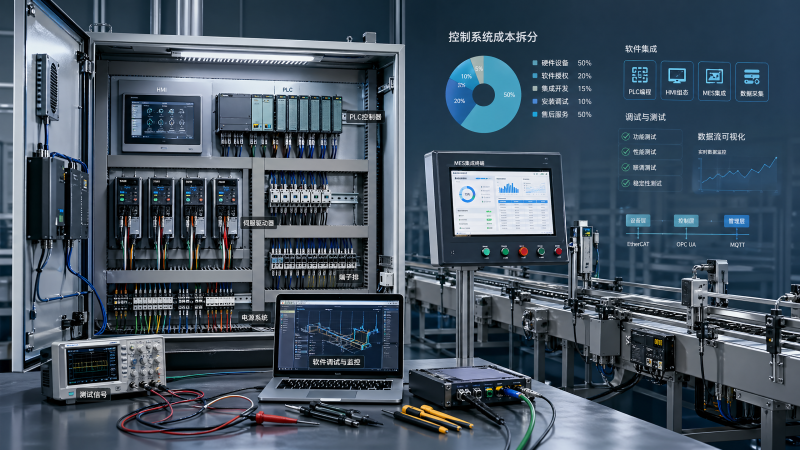
A fair control systems cost breakdown should clarify more than hardware alone—it must connect control systems cost with industrial automation price, automation engineering quotation, motion control price, and even MES software price where integration matters. For buyers, operators, and decision-makers, transparent costing reduces risk, improves supplier comparison, and supports smarter investments across modern factory automation projects.
In practical terms, a quotation that lists only a PLC, an HMI, and a control cabinet is not enough. A real project budget often includes design hours, field wiring, software development, safety validation, FAT and SAT activities, commissioning, operator training, and future support. When these items are hidden or merged into vague line entries, procurement teams cannot compare bids fairly, and plant managers cannot forecast total ownership cost over 3 to 7 years.
For manufacturers navigating Industry 4.0 investments, transparent costing is also a technical issue. Control architecture affects cycle time, uptime, expandability, and cybersecurity exposure. At G-IFA, the focus is not simply on lower purchase price, but on benchmark-driven cost visibility across PLC and control systems, motion control, industrial software, and integration work that shapes the real value of a modern production line.
What a fair control systems cost breakdown should cover
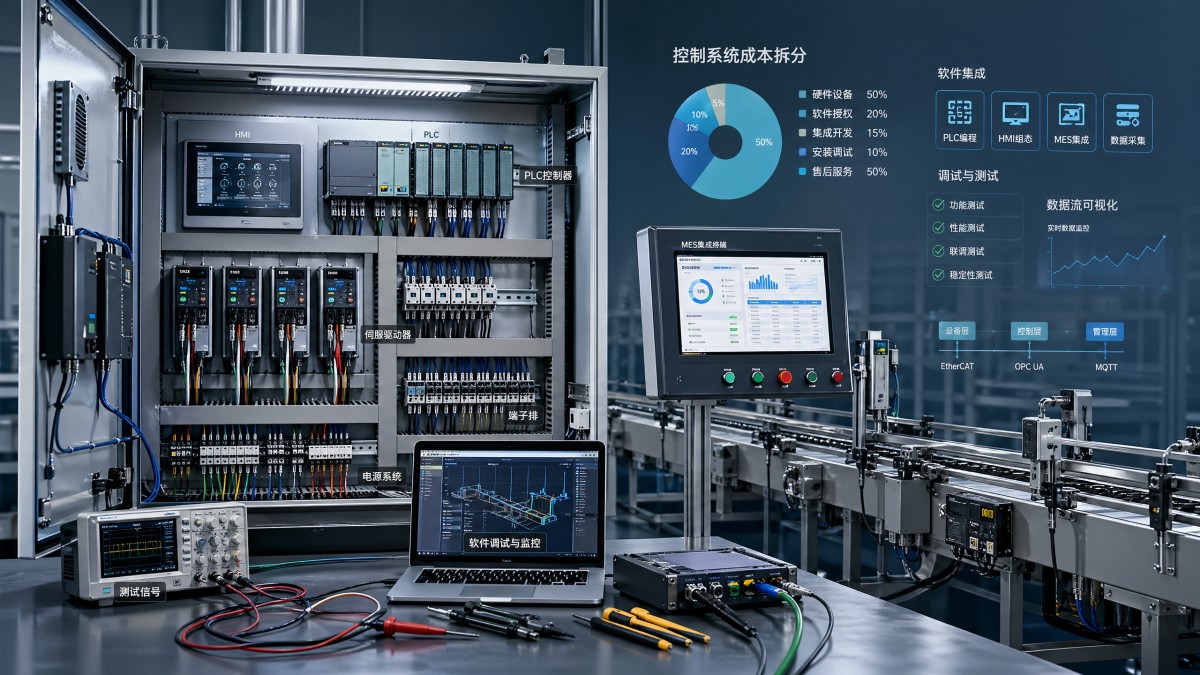
A fair control systems cost breakdown should separate costs into clear engineering and delivery categories. In most industrial automation projects, the control package represents only part of the total industrial automation price. A buyer should be able to see how much is allocated to hardware, software, engineering labor, testing, documentation, installation support, and post-startup service. Without that separation, a quotation may appear competitive while masking expensive change orders later.
In many factories, hardware accounts for roughly 30% to 50% of the visible quotation, while engineering, programming, panel build, and commissioning can account for another 25% to 45%. The exact ratio depends on system complexity. A stand-alone conveyor control panel may need only 40 to 80 engineering hours, while a multi-axis packaging line with MES connectivity may require 250 to 600 hours across electrical design, PLC logic, HMI screens, servo tuning, and integration testing.
The table below outlines the cost categories that should be visible in a transparent automation engineering quotation. It is not a universal price list, but a structure that helps technical and commercial teams compare offers on equal terms.
The key takeaway is simple: a fair quote makes line-item logic visible. Even if exact labor rates are confidential, the supplier should still provide measurable scope such as number of I/O points, number of HMI pages, number of servo axes, estimated commissioning days, and whether factory testing is included. This allows users, purchasing teams, and decision-makers to compare value rather than only initial price.
Minimum line items buyers should request
At a minimum, request separate visibility for 8 key items: controls hardware, cabinet fabrication, electrical design, PLC programming, HMI development, motion setup, commissioning, and documentation. If the project includes batch reporting, traceability, or OEE dashboards, MES software price and interface scope should also be identified. A one-line “automation package” total is rarely sufficient for a serious capital decision.
Common hidden charges
- Additional I/O expansion after design freeze, often billed after panel layout is complete
- On-site support beyond the first 3 to 5 startup days
- Third-party device protocol integration such as Modbus TCP, EtherNet/IP, or OPC UA
- Software license renewals, historian connectors, or remote service subscriptions
When these items are identified early, the automation engineering quotation becomes a planning tool rather than a negotiation trap.
How system complexity changes the total industrial automation price
Not all control projects should be priced the same way. The industrial automation price for a basic machine retrofit differs significantly from a greenfield line with robotics, servo motion, and MES connectivity. Complexity is shaped by at least 5 variables: I/O count, number of controlled axes, safety architecture, communication protocols, and software integration depth. If a quote ignores these variables, it is difficult to judge whether the control systems cost is fair.
For example, a simple pump skid may involve fewer than 80 digital and analog points, no coordinated motion, and one local HMI. In contrast, a high-speed assembly or packaging line may include 250 to 1,000 I/O points, 4 to 20 servo axes, safety PLC logic, vision triggers, recipe management, and line-level data collection. The second scenario naturally carries a higher motion control price and more commissioning risk, even if cabinet hardware appears similar at first glance.
The following comparison helps explain how scope changes cost structure and resource demand across common automation scenarios.
The most important conclusion is that hardware similarity does not guarantee equal project effort. Two bids using the same PLC family can still differ by 20% to 40% if one supplier includes tested motion profiles, alarm strategy, remote diagnostics, and validation documents while the other excludes them. Buyers should therefore compare scope maturity, not only branded component lists.
Where motion control price usually grows
Motion control price typically increases when accuracy, synchronization, or throughput targets become tighter. A positioning tolerance of ±1.0 mm is not the same engineering task as ±0.1 mm under repeat high-speed cycles. Costs rise with servo axis count, camming requirements, electronic gearing, load inertia matching, and tuning time. Mechanical factors also matter: backlash, coupling quality, and transmission stiffness can increase software and startup effort even before production begins.
Complexity indicators to ask suppliers about
- How many physical I/O points and how many remote I/O stations are included?
- How many variable-frequency drives or servo axes require setup and tuning?
- Is safety implemented with relays only, or with a safety PLC and safe motion functions?
- Are there 1, 2, or 3 software layers such as machine control, line supervision, and MES interface?
- How many FAT days and on-site commissioning days are included in the quotation?
These questions help transform a broad automation engineering quotation into a scope document that can be benchmarked with much greater confidence.
How to evaluate engineering, software, and MES-related costs fairly
Engineering and software are often the least transparent parts of a control systems cost breakdown. Yet these items strongly influence uptime, maintainability, and future line expansion. A low quotation with weak code structure, poor alarm handling, or limited documentation may create years of support cost. For that reason, procurement should review not only hourly rates but also scope definition, deliverables, change-control boundaries, and long-term software ownership.
In many projects, PLC programming and HMI development are quoted as a combined lump sum. That approach can be acceptable if it is paired with measurable deliverables. Examples include 25 to 60 HMI screens, alarm categorization by severity, recipe storage requirements, trend logs, user-level permissions, backup files, and revision-controlled source code. If MES software price is relevant, the quote should state whether the supplier includes only interface tags or also dashboards, historian mapping, production order logic, and ERP handshakes.
A practical review framework is shown below. It helps decision-makers distinguish between software that is merely functional and software that is ready for sustained industrial use.
The commercial lesson is clear: if software scope is not described, neither the automation engineering quotation nor the total industrial automation price is complete. Factories planning digital expansion should confirm whether the project includes only machine control, or a path to line analytics, traceability, and system-level reporting over the next 12 to 36 months.
Questions to ask before approving software-related cost
- Are software licenses perpetual, subscription-based, or dependent on annual support?
- Is remote diagnostic access included, and who manages cybersecurity approval?
- Will the supplier deliver open, maintainable source code or only compiled files?
- How many integration test cycles are included before extra engineering charges apply?
Why this matters for operators
Operators and maintenance teams experience hidden software cost first. If alarm messages are vague, if fault recovery requires engineering support, or if trends cannot show root causes, downtime lengthens. A fair breakdown therefore protects not only purchasing budgets, but also day-to-day production stability.
Procurement checkpoints, risk controls, and acceptance criteria
A transparent cost breakdown becomes far more useful when linked to procurement checkpoints. In industrial projects, cost fairness is not only about line items, but also about what triggers payment and what defines completion. Buyers should align the quotation with at least 4 commercial gates: design approval, panel completion, FAT completion, and SAT or production acceptance. This structure reduces ambiguity and gives both parties measurable milestones.
Risk control should begin before purchase order release. For example, if a supplier offers a low controls hardware price but excludes CE-related panel documentation, network diagrams, or spare parts lists, the total project burden shifts to the factory. Similarly, a quotation that includes only 2 commissioning days for a complex line may create immediate overrun risk. Typical startup windows range from 2 to 5 days for simple skids and 2 to 4 weeks for integrated lines, depending on process stability and third-party equipment readiness.
The checklist below can help purchasing teams, engineers, and decision-makers evaluate whether a control systems cost breakdown is commercially safe and technically complete.
- Confirm commercial scope by quantity: number of cabinets, I/O points, axes, HMIs, and software interfaces.
- Require acceptance definition: FAT criteria, SAT criteria, and evidence documents such as test sheets or alarm lists.
- Verify spare and support terms: recommended spare modules, response time targets, and remote support availability.
- Define change-order rules: what happens if the process owner changes tag counts, recipes, or reporting logic after design freeze.
- Review ownership and lifecycle issues: software backup, license transferability, and obsolescence planning for 5 to 10 years.
Acceptance criteria should be specific enough to be tested in production conditions. Rather than saying “system runs normally,” define measurable outcomes such as alarm response behavior, communication stability over an 8-hour test window, motion repeatability within an agreed tolerance, and successful exchange of required MES tags. Precise acceptance terms often prevent disputes more effectively than aggressive price negotiation.
Typical procurement mistakes
Three mistakes appear frequently. First, buyers compare only hardware brands while ignoring engineering scope. Second, they approve integration assumptions without a tested protocol map. Third, they underestimate training and support needs for operators. Each of these gaps can raise the real industrial automation price long after the purchase order is signed.
A practical 5-step review process
- Map process requirements and define the control boundary.
- Request separated pricing for hardware, software, commissioning, and interfaces.
- Benchmark labor scope against I/O count, axis count, and software complexity.
- Validate FAT, SAT, and documentation deliverables before contract release.
- Review lifecycle cost including support, updates, and expansion capacity.
This process does not slow procurement. In many cases, it shortens decision time because stakeholders can compare quotations with fewer assumptions and less internal rework.
FAQ: common questions about control systems cost and automation quotations
Many buyers ask similar questions when evaluating a control systems quotation. The answers usually depend on technical scope, but several principles remain consistent across sectors such as packaging, material handling, assembly, utilities, and process support systems.
How many quotations should a buyer compare?
For medium-value automation projects, comparing 2 to 3 qualified quotations is often enough if the scope is well defined. More than 3 can create noise if specifications are inconsistent. The priority is not quantity of bids, but consistency of scope: identical I/O assumptions, the same motion requirements, the same FAT expectations, and the same software interface boundary.
When does MES software price need to appear in the same breakdown?
MES software price should appear when the project includes production reporting, recipe download, work-order tracking, traceability, downtime collection, or ERP data exchange. If the supplier only provides machine-level tags and another party builds the MES layer, that commercial boundary should still be stated. Otherwise, integration responsibility becomes unclear during startup.
What commissioning duration is realistic?
A small stand-alone control panel may need 2 to 5 days including checkout and operator handover. A servo-based cell may require 1 to 2 weeks. An integrated production line with robotics, motion control, safety validation, and software connectivity may require 2 to 4 weeks or more, especially if upstream and downstream machines are supplied by different vendors.
What signs suggest a quotation is incomplete?
Warning signs include missing I/O counts, no mention of FAT or SAT, vague software wording, no spare parts recommendation, no training scope, and no stated protocol responsibility for third-party devices. If the quote has a low total but weak delivery detail, the total industrial automation price may rise later through rework and change orders.
How can buyers reduce lifecycle cost, not just purchase price?
Prioritize maintainable architecture, documented code, standard components, and realistic support terms. A slightly higher initial control systems cost can be justified when it reduces troubleshooting time, spare inventory complexity, or software dependency over the next 5 to 10 years. This is especially true for lines that run multiple shifts and cannot tolerate long downtime windows.
A fair control systems cost breakdown should make technical scope, engineering effort, software responsibility, and acceptance criteria visible from the start. That clarity helps information researchers compare options, helps operators prepare for maintainability, helps procurement negotiate from facts, and helps decision-makers align automation spending with long-term plant performance.
For organizations evaluating PLC and control systems, motion control, industrial software, and line integration, G-IFA supports a more disciplined review process through benchmark-oriented technical insight and cross-sector cost transparency. If you are planning a retrofit, a new production cell, or a connected factory upgrade, now is the right time to validate your quotation structure before committing capital.
Contact us to discuss your project scope, get a more transparent automation engineering quotation framework, and explore smarter cost benchmarks for your next industrial automation investment.
Recommended News
- 2026/06/20Waste Reduction in Manufacturing: Practical Ways to Cut Scrap, Rework, and Disposal CostsWaste reduction in manufacturing starts upstream. Learn practical ways to cut scrap, rework, and disposal costs with smarter controls, better data, and proven process fixes.
- 2026/06/20Smart Home Setup Guide: How to Choose Devices That Work Together ReliablySmart home setup guide: learn how to choose compatible devices, compare Matter, Zigbee, Z-Wave, and Wi-Fi, avoid common mistakes, and build reliable automations that work every day.
- 2026/06/20Thermal Barcode Labels for Warehousing: Materials, Durability, and Print Method Differencesthermalbarcodelabels for warehousing: compare materials, durability, and direct thermal vs thermal transfer printing to improve scan accuracy, reduce relabeling, and choose the right label faster.