
Search News
Industry Portal
Popular Tags
Smart Hotel IoT Use Cases: Where Connected Systems Improve Guest Service and Operations
Author
Lina Cloud
Time
Jun 06, 2026
Pageviews
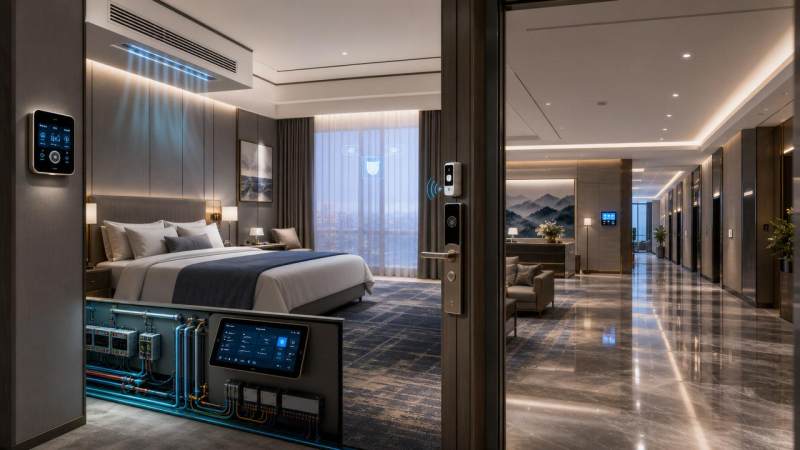
Where smart hotel IoT creates value first
Smart hotel IoT works best when it solves specific operational friction, not when it is treated as a general technology upgrade.
In hospitality, guest comfort, building efficiency, and service speed are tightly linked. A room issue can become a staffing issue within minutes.
That is why connected systems matter. They connect room controls, maintenance alerts, occupancy signals, and service workflows into one operating view.
The real question is not whether smart hotel IoT is useful. It is where it fits, what it should control, and how much integration is justified.
This is also where industrial thinking helps. G-IFA often frames automation around verifiable data, interoperability, and lifecycle risk, and hotels benefit from the same discipline.
A connected thermostat may look simple. In practice, its value depends on sensor reliability, control logic, PMS links, and response time during occupancy changes.
Actual deployment depends on property type and operating rhythm
Different hotels ask different things from smart hotel IoT because their operating rhythm is different.
A luxury urban property usually prioritizes seamless comfort and discreet service. A resort often cares more about distributed assets, energy zones, and mobility across large grounds.
Limited-service hotels often focus on reducing repetitive labor. Mixed-use buildings need stronger coordination between guest areas, shared facilities, and back-of-house systems.
The same device can therefore serve very different goals. Door sensors may support security in one property, housekeeping timing in another, and HVAC setback in a third.
A practical evaluation usually starts with three variables:
- How often does the process happen each day?
- How costly is a delay, complaint, or equipment failure?
- Can the signal trigger an action automatically, or only inform a person?
Where frequency and impact are both high, smart hotel IoT usually delivers the clearest return.
Guest rooms are the most visible use case, but not the simplest one
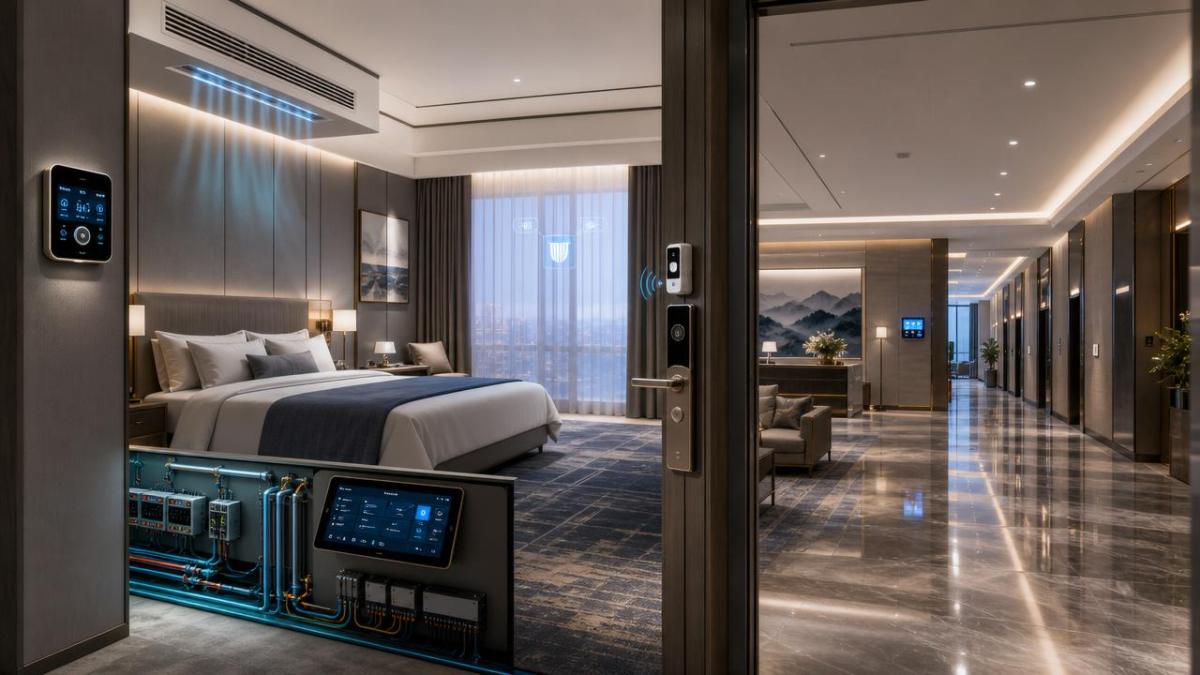
Connected guest rooms are often the first smart hotel IoT project because the service effect is easy to see.
Common functions include mobile access, occupancy-based lighting, climate presets, curtain control, minibar monitoring, and voice or app-based requests.
Yet room automation is not only about convenience. It changes energy use, maintenance timing, and even front desk exception handling.
For example, occupancy-aware HVAC saves more when linked to check-in status and window sensors. Without that logic, comfort complaints can rise.
In higher-end properties, the judgment point is usually invisible experience. Guests should not feel they are learning a control system.
In midscale properties, simpler interfaces often outperform feature-heavy rooms. Fewer controls mean fewer support calls and faster room turns.
A useful rule is to automate what changes repeatedly, not what changes rarely. Temperature mode and occupancy status matter more than novelty scenes.
What usually matters more than feature count
- Recovery behavior after network loss or power interruption
- Latency between sensor input and room response
- Compatibility with PMS, BMS, and door lock platforms
- Manual override options for guests and staff
Back-of-house gains often come from maintenance and service coordination
Some of the strongest smart hotel IoT returns appear away from the guest room.
Connected chillers, pumps, elevators, kitchen equipment, laundry systems, and air handling units can report performance drift before failure becomes visible.
This is where predictive maintenance becomes practical. Hotels rarely need every machine on advanced analytics. Critical assets with costly downtime should come first.
A failing fan coil in one room creates inconvenience. A fault in central hot water or ventilation can disrupt large parts of the property.
Service coordination also improves when room status, guest requests, and engineering tickets share the same event stream.
If a room is marked vacant-clean, a thermostat anomaly should not wait for a complaint. It should create a maintenance task before the next arrival.
This mirrors broader Industry 4.0 logic. Data has value when it drives workflow, not when it sits in a dashboard.
Public areas need different logic from private rooms
Lobbies, meeting floors, spas, restaurants, and corridors create a different smart hotel IoT profile.
These areas are less about personal preference and more about traffic patterns, safety, comfort stability, and staffing response.
Occupancy sensing in a conference level can adjust fresh air delivery, digital signage, cleaning schedules, and queue management.
Pool and spa areas often require closer environmental monitoring. Humidity, air quality, and equipment condition directly affect guest experience and facility wear.
Restaurants may benefit from refrigeration alerts, kitchen equipment monitoring, and timed service coordination more than from guest-facing automation.
In these settings, the best smart hotel IoT design balances sensor density with operational clarity. Too many alerts can slow teams instead of helping them.
Different scenarios change the decision criteria
It helps to compare use cases by what they really need, not by device category.
This is why one deployment model rarely fits every property in a portfolio.
Where projects go wrong before rollout is even finished
A common mistake is choosing smart hotel IoT around device specifications alone.
Hotels often underestimate integration effort, commissioning time, wireless interference, battery replacement cycles, and staff training needs.
Another misread is assuming similar rooms have identical requirements. Suites, accessible rooms, adjoining rooms, and extended-stay units can behave differently.
There is also a tendency to over-automate edge cases. If a process happens rarely, manual handling may remain more reliable and cheaper.
Cybersecurity and standards alignment are sometimes reviewed too late. Connected access, occupancy data, and control networks need clear segmentation and governance.
The industrial automation world learned this early. Reliable systems depend on interface discipline, fail-safe behavior, and tested compatibility, not only on feature promises.
A practical way to match smart hotel IoT to the right use case
Start with a short map of operational pain points. Use actual incidents, response times, and energy patterns rather than assumptions.
Then separate visible guest problems from hidden cost drivers. Both matter, but they justify different technology depth.
- Prioritize use cases with frequent events and measurable service impact
- Check whether existing PMS, BMS, and lock systems can exchange data cleanly
- Define fallback behavior for connectivity loss and manual override
- Estimate maintenance effort, not just installation cost
- Pilot in a representative area, not only in showcase rooms
When benchmarking options, a data-led approach similar to G-IFA’s engineering lens is useful.
Compare response accuracy, interoperability, lifecycle support, and standards alignment alongside energy savings or guest app features.
Smart hotel IoT delivers the strongest results when each connected layer has a clear operational purpose.
The next step is usually straightforward: define the property scenarios, rank the friction points, and test where connected automation changes outcomes most reliably.
Recommended News
- 2026/06/25What Does Global Chain Mean in Supply Networks and Where Do Disruptions Usually Start?Global chain risks often begin upstream, not at delivery. Learn where disruptions start, how hidden data and standards gaps spread, and how to strengthen supply network resilience.
- 2026/06/25How to Choose a Photovoltaic Solar Panels Manufacturer in Germany for Commercial ProjectsPhotovoltaic solar panels manufacturer in Germany selection starts with more than price. Discover how to compare quality, compliance, delivery, and long-term reliability for commercial solar projects.
- 2026/06/25Rail Freight vs Sea Freight for Heavy Cargo: Cost, Transit Time, and Risk ComparedRail freight vs sea freight for heavy cargo: compare cost, transit time, and risk to choose the best shipping mode for industrial equipment, tighter schedules, and smarter logistics decisions.