
Search News
Industry Portal
Popular Tags
CNC control upgrades that improve precision without full replacement
Author
Dr. Isaac Logic
Time
May 15, 2026
Pageviews
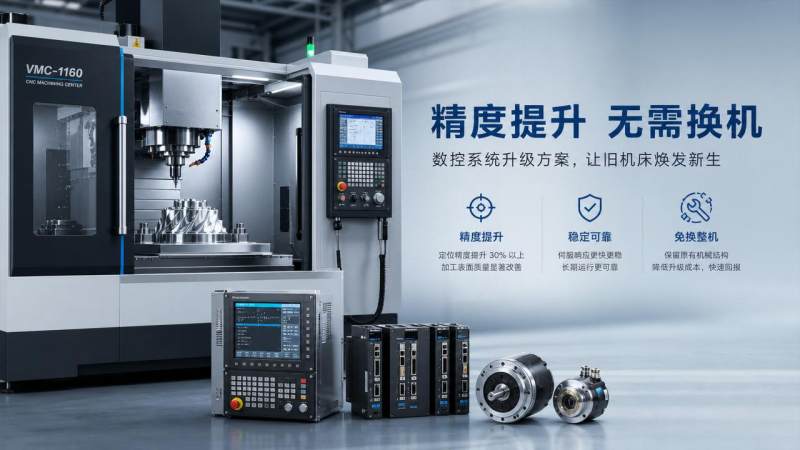
For technical evaluators under pressure to improve machining accuracy without disrupting production, CNC control upgrades offer a practical path forward. Instead of replacing entire machines, targeted improvements in control hardware, feedback systems, and software tuning can raise precision, stability, and data visibility while reducing investment risk. This article explores how to assess upgrade options that deliver measurable performance gains in modern manufacturing environments.
What does a CNC control upgrade actually improve?
A CNC control upgrade improves how a machine interprets commands, manages motion, and reacts to feedback in real time.
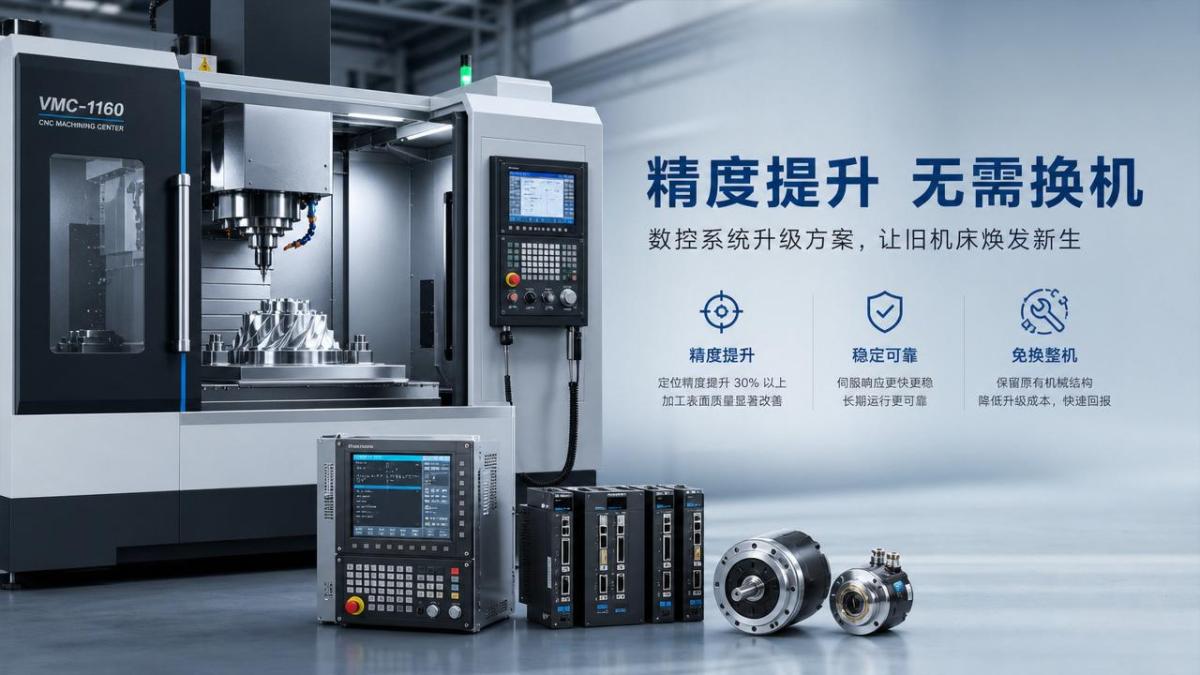
Precision is not only about spindle quality or casting rigidity. Control quality strongly affects contouring, repeatability, and thermal stability.
Older CNC control platforms often struggle with interpolation speed, servo response, and high-resolution position feedback.
That limitation appears as corner rounding, inconsistent surface finish, backlash compensation drift, or unstable cycle results.
A modern CNC control upgrade may include a faster processor, higher encoder resolution, improved servo loops, and better compensation algorithms.
It can also add Ethernet communication, diagnostics, remote access, and data collection for smarter production oversight.
- Better path accuracy during complex contours
- More stable axis synchronization
- Faster processing of look-ahead toolpaths
- Improved repeatability across shifts
- Clearer alarm history and maintenance visibility
In mixed production environments, these gains often matter more than raw speed. They reduce scrap and lower uncertainty during part qualification.
When is upgrading CNC control better than replacing the entire machine?
A CNC control upgrade makes sense when the machine structure remains mechanically sound and process demand has outgrown the original control.
If guideways, ball screws, spindle condition, and geometric alignment are still acceptable, replacement may be unnecessary.
This is common in robust machine tools with durable frames but outdated electronics or unsupported software.
An upgrade is often favorable when downtime windows are limited. Full replacement usually involves longer commissioning and retraining.
It is also useful when legacy equipment supports a validated process that should not be disturbed unnecessarily.
Upgrade is usually suitable when:
- Machine geometry can still hold tolerance
- Spindle and axis mechanics are serviceable
- Control obsolescence causes more problems than mechanics
- Current parts need better finish or repeatability
- A plant needs digital connectivity without major layout changes
Replacement may be better when:
- Base casting or slide system has severe wear
- Spindle performance no longer matches application needs
- Safety compliance cannot be economically restored
- Required productivity depends on a completely different machine concept
The best decision starts with measurement, not assumptions. Laser calibration, ballbar testing, and servo analysis reveal where error truly comes from.
Which CNC control components deliver the biggest precision gains?
Not every CNC control upgrade creates the same value. Precision gains usually come from several coordinated improvements rather than one isolated part.
1. Motion processor and interpolation capability
A faster control kernel handles dense toolpaths better. That reduces lag during fine contouring and high-speed machining.
2. Servo drives and tuning logic
Modern digital drives improve following error control. Better autotuning and gain optimization support smoother acceleration and deceleration.
3. Encoder and feedback resolution
Higher resolution feedback helps the CNC control detect smaller motion deviations. Closed-loop accuracy improves especially on demanding finishing paths.
4. Compensation functions
Backlash, pitch error, thermal growth, and squareness compensation can significantly improve results when configured with verified measurement data.
5. HMI, diagnostics, and connectivity
These do not directly cut tighter parts. However, they help sustain precision through trend monitoring, alarm analysis, and faster root-cause investigation.
In many factories, the strongest CNC control result comes from combining feedback upgrades with servo optimization and compensation mapping.
How should upgrade options be compared before investment?
A technical comparison should focus on measurable performance, compatibility, lifecycle support, and implementation risk.
Many upgrade proposals look similar on paper. Differences often appear in integration depth, software openness, and service capability.
A CNC control evaluation should also include proof targets. Ask for expected improvement in repeatability, surface finish consistency, and alarm reduction.
Where possible, compare based on test cuts, circularity results, and cycle stability rather than only brochure specifications.
What risks and misconceptions can limit CNC control upgrade results?
The biggest misconception is that a CNC control upgrade can compensate for serious mechanical deterioration. It cannot fix every source of error.
Another common mistake is focusing only on the control screen or processor while ignoring motors, encoders, power quality, and cabinet condition.
Precision depends on the entire control loop. Weakness in one layer can cancel the value of improvements elsewhere.
Frequent upgrade risks
- Insufficient baseline measurement before retrofit
- Poor servo tuning after hardware installation
- Encoder mismatch or signal noise issues
- Thermal compensation enabled without stable data
- Operator interface changes without process validation
There is also a data risk. New CNC control platforms may generate useful information, but only if integrated into maintenance and quality workflows.
Without that discipline, the retrofit becomes a hardware event instead of a precision management improvement.
How can implementation be planned to reduce downtime and protect ROI?
A successful CNC control project starts with a structured audit. Mechanical health, electrical condition, software needs, and production constraints must be documented.
Implementation should then move through defined stages rather than a single rushed shutdown.
- Capture baseline accuracy, repeatability, and alarm history
- Confirm retrofit scope and compatibility details
- Prepare backup logic, parameters, and wiring records
- Install hardware during a planned service window
- Tune axes and validate compensation functions
- Run qualification parts and compare measured outcomes
- Connect new CNC control data to maintenance routines
Downtime can often be reduced by preassembling electrical panels, simulating logic offline, and sequencing one machine at a time.
ROI improves when the CNC control retrofit also supports predictive maintenance, traceability, and standardized diagnostics across multiple assets.
Quick FAQ comparison table
CNC control upgrades can deliver meaningful precision improvement without full machine replacement, but only when decisions are grounded in measured machine condition and realistic goals.
For industrial automation environments, the strongest outcomes come from linking control performance with diagnostics, standards-based integration, and long-term maintainability.
A practical next step is to benchmark current error sources, define target tolerances, and compare CNC control options against both machining results and digital integration needs.
That approach supports lower risk, clearer ROI, and more reliable progress toward smarter, more precise production systems.
Recommended News
- 2026/10/24Car Spare Parts: How to Check Fitment and Avoid Ordering the Wrong PartOrder car spare parts with confidence. Learn how to verify VINs, OEM numbers, and fitment details to avoid costly mistakes and choose the right replacement first time.
- 2026/10/23How Do You Select a Motion Control System for Synchronized Axes?How do I select a motion control system for synchronized axes? Discover key timing, feedback, and performance checks to choose confidently and reduce costly integration risks.
- 2026/10/23Integrating End-of-Line Sortation with Packing Stations and Conveyor ControlsOptimize end of line sortation with coordinated packing stations and conveyor controls. Learn how to prevent bottlenecks, improve routing accuracy, and handle exceptions reliably.