
Search News
Industry Portal
Popular Tags
Industrial PC thermal management failures often start small
Author
Dr. Isaac Logic
Time
May 17, 2026
Pageviews
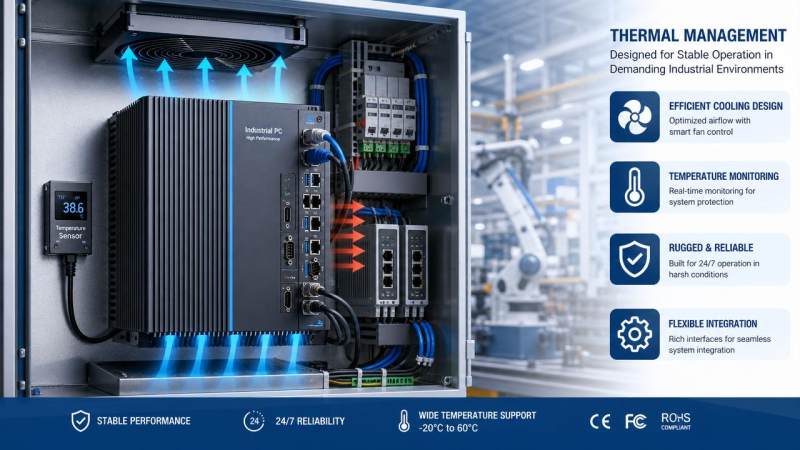
Industrial PC thermal management issues rarely begin with alarms or sudden failure. They usually emerge as small, repeatable deviations in heat, airflow, and power behavior.
In automation environments, these early signs matter because thermal instability can slowly degrade CPUs, storage, controllers, and communication interfaces before anyone notices visible downtime.
For industrial operations, effective industrial pc thermal management is not only a maintenance topic. It supports uptime, process accuracy, cybersecurity reliability, and longer asset life.
Within the G-IFA perspective, thermal control should be evaluated like any other engineering benchmark. It must be measured, compared, documented, and linked to real production risk.
Industrial PC thermal management basics
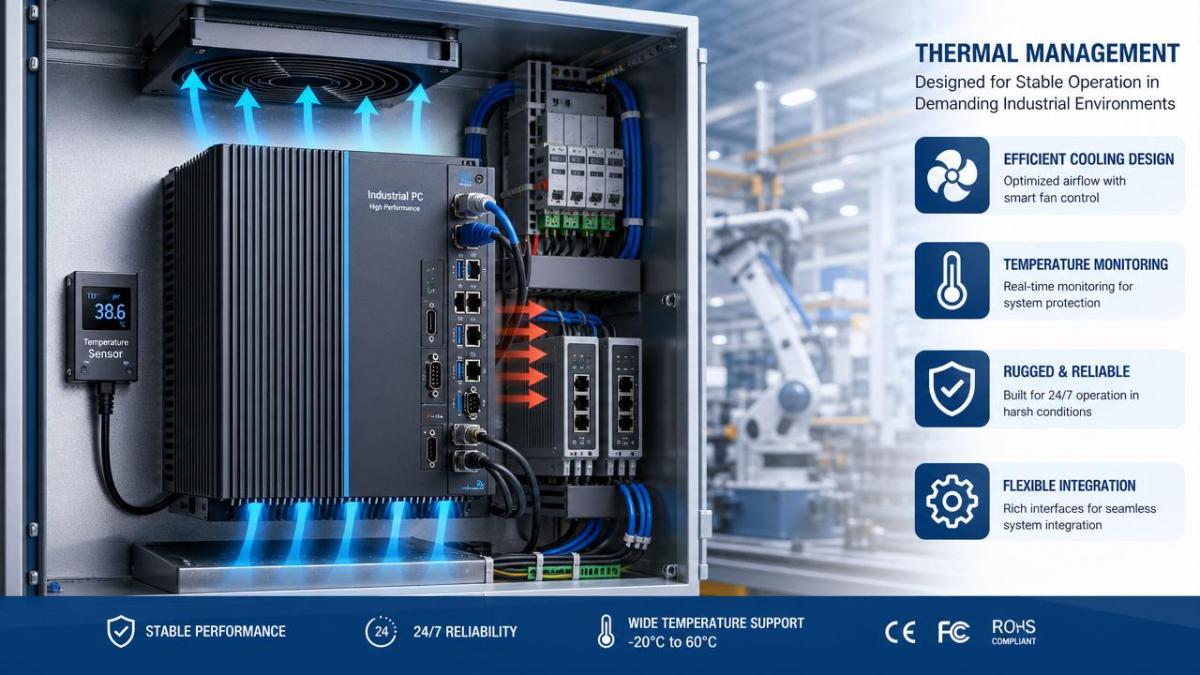
Industrial pc thermal management refers to the methods used to control internal temperatures in rugged computing systems operating on factory floors, mobile equipment, and process infrastructure.
It includes heat sinks, fans, ventilation paths, thermal interface materials, enclosure design, sensor monitoring, and firmware logic that reacts to rising temperatures.
Unlike office computers, industrial PCs often face dust, vibration, oil mist, sealed cabinets, and unstable ambient conditions. These factors make heat removal more difficult.
Even small thermal inefficiencies can trigger throttling, communication lag, storage errors, or shortened component lifespan. That is why industrial pc thermal management deserves continuous attention.
A reliable thermal design balances component density with airflow, surface cooling, and maintenance access. Good design also anticipates real contamination, not only laboratory conditions.
Common heat sources inside industrial PCs
- Processors running analytics, HMI graphics, edge AI, or machine vision workloads
- Power supplies and voltage regulators under unstable load conditions
- Solid-state storage exposed to write-intensive data logging
- Add-on I/O cards, fieldbus modules, and GPU accelerators
- Poor cabinet airflow around otherwise capable hardware
Why small thermal failures gain industry attention
Across sectors, factories are increasing compute intensity at the edge. More data processing now happens near machines, where thermal exposure is often worst.
As Industry 4.0 expands, industrial PCs support PLC connectivity, MES transactions, robotics coordination, and quality data capture in one compact footprint.
That convergence raises thermal stress. A device once sized for simple visualization may now run analytics, OPC UA services, and remote diagnostics simultaneously.
The result is a growing focus on industrial pc thermal management as a risk indicator, not merely a hardware specification line.
Business value of stronger thermal control
Good industrial pc thermal management protects more than electronics. It preserves process continuity, maintenance planning accuracy, and confidence in digital production systems.
When temperatures remain stable, systems avoid hidden performance drops. This matters where cycle time, synchronization, or traceability data depend on consistent computing behavior.
Thermal discipline also reduces emergency parts replacement. Components usually age faster under repeated heat stress, especially storage, power stages, and fan assemblies.
From a benchmarking viewpoint, thermal reliability should be considered alongside IEC compliance, enclosure rating, vibration tolerance, and software resilience.
Operational benefits often seen
- Lower risk of unplanned line stoppage
- More predictable preventive maintenance intervals
- Improved lifespan of SSDs, CPUs, and power modules
- Better stability for MES, SCADA, and edge applications
- Cleaner root-cause analysis after incidents
Typical scenarios where industrial pc thermal management fails first
Not all installations fail the same way. Industrial pc thermal management issues usually reflect the surrounding process, cabinet design, and workload profile.
Practical checks for early thermal warning signs
A useful inspection routine should detect change before failure. That means recording normal temperature baselines during stable production, then comparing future readings.
Industrial pc thermal management improves when teams review both component data and environmental context. A clean CPU graph means little inside an overheating cabinet.
- Log CPU, motherboard, SSD, and inlet air temperatures by shift.
- Track fan RPM trends, noise changes, and restart behavior.
- Inspect vents, filters, cable congestion, and neighboring heat sources.
- Compare peak loads against the original thermal design assumptions.
- Review firmware thresholds, BIOS fan logic, and event logs.
- Use thermal imaging when sensor values look normal but failures continue.
Frequent blind spots
One blind spot is assuming fan rotation equals healthy cooling. Fans can spin while delivering poor airflow because of dirt, blade damage, or pressure imbalance.
Another blind spot is focusing only on processor temperature. Storage devices, DC converters, and network interfaces may reach harmful temperatures first.
A third blind spot is ignoring seasonal variation. Industrial pc thermal management often appears acceptable in winter, then fails during summer peaks.
Engineering considerations for more resilient deployments
Thermal resilience starts during selection and integration. Hardware should be matched to actual duty cycle, cabinet geometry, and contamination profile.
Fanless designs can reduce dust entry, but they still need proper heat dissipation surfaces and ambient temperature margins. Sealed does not mean thermally immune.
Systems with active cooling may perform better under burst workloads, yet they require a maintenance plan for filters, bearings, and airflow verification.
G-IFA benchmarking logic favors evidence-based evaluation. Review test data under realistic loads, verify compliance claims, and compare design margins against field conditions.
- Check operating temperature range against measured site conditions
- Validate enclosure layout before adding new compute functions
- Prefer accessible sensor diagnostics and alarm integration
- Document thermal baselines after every major software upgrade
- Align cooling strategy with ISO, IEC, CE, and site safety constraints
Next-step actions for thermal risk reduction
A structured thermal review can quickly reveal whether an industrial PC is operating with safe margin or drifting toward failure.
Start with one production area, collect baseline temperatures, inspect airflow paths, and compare real loads with the original industrial pc thermal management design.
Then rank systems by criticality, contamination exposure, and thermal trend instability. This creates a practical roadmap for cleaning, redesign, sensor upgrades, or hardware replacement.
In complex automation environments, small thermal failures should never be treated as minor noise. They are often the first measurable sign of larger reliability risk.
Using benchmark-driven review and disciplined maintenance, industrial pc thermal management becomes a controllable engineering variable rather than an expensive surprise.
Recommended News
- 2026/10/24Car Spare Parts: How to Check Fitment and Avoid Ordering the Wrong PartOrder car spare parts with confidence. Learn how to verify VINs, OEM numbers, and fitment details to avoid costly mistakes and choose the right replacement first time.
- 2026/10/23How Do You Select a Motion Control System for Synchronized Axes?How do I select a motion control system for synchronized axes? Discover key timing, feedback, and performance checks to choose confidently and reduce costly integration risks.
- 2026/10/23Integrating End-of-Line Sortation with Packing Stations and Conveyor ControlsOptimize end of line sortation with coordinated packing stations and conveyor controls. Learn how to prevent bottlenecks, improve routing accuracy, and handle exceptions reliably.