
Search News
Industry Portal
Popular Tags
Servo motors cost is not just unit price anymore
Author
Marcus Torque
Time
May 05, 2026
Pageviews
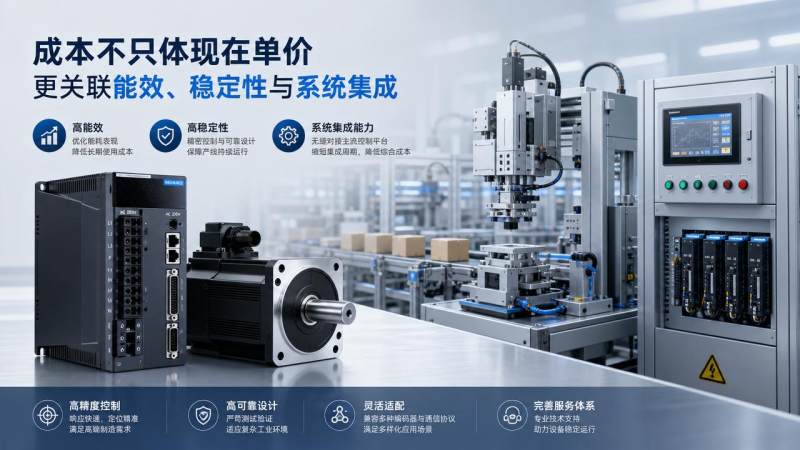
Servo motors cost is no longer defined by unit price alone. For project managers and engineering leaders, the real calculation now includes lifecycle performance, integration complexity, energy efficiency, downtime risk, and long-term maintenance value. As smart factories demand higher precision and faster ROI, understanding what truly drives servo motors cost is essential for making reliable, future-ready automation decisions.
Why servo motors cost changes from one application scenario to another
In industrial projects, two servo motors with similar torque ratings may create very different total project outcomes. One may run in a high-speed packaging line with frequent starts and stops, while another may support a precision indexing table in electronics assembly. The unit price may look comparable, but the true servo motors cost will diverge once you factor in commissioning time, tuning effort, energy consumption, software compatibility, spare part strategy, and the cost of unexpected stoppages.
For project leaders, this is where cost evaluation often fails. Procurement teams may focus on the purchase line item, yet operations teams later absorb hidden expenses through maintenance calls, encoder failures, oversizing, poor synchronization, or difficult integration with PLC and motion control systems. In a smart manufacturing environment, servo motors cost must be judged in context: production speed, product variability, quality tolerance, operator capability, and digital connectivity all matter.
This is especially relevant to organizations building or upgrading automated lines under Industry 4.0 frameworks. At G-IFA, cross-sector benchmarking consistently shows that the most cost-effective servo solution is not always the cheapest motor. It is the option that aligns best with the application scenario, international standards, long-term reliability targets, and the factory’s integration architecture.
Typical business scenarios where servo motors cost becomes a strategic issue
Servo motors are used across robotics, conveying, winding, pick-and-place systems, CNC support axes, packaging machines, AGV subsystems, and precision assembly cells. Yet not every scenario justifies the same level of investment. Project managers should start by identifying which operating pattern drives cost most strongly.
High-speed packaging and converting lines
In packaging, labeling, sealing, and film handling applications, cycle speed and repeatability are critical. Here, servo motors cost is heavily influenced by acceleration capability, thermal performance, response time, and synchronization with upstream and downstream stations. A lower-cost motor that struggles with dynamic loads can create product waste, line instability, and frequent tuning intervention.
Precision electronics and semiconductor-adjacent assembly
Where micron-level positioning or highly consistent motion profiles matter, the cost discussion shifts toward encoder resolution, vibration control, feedback accuracy, and clean control behavior. In this scenario, servo motors cost includes the value of process yield. Even a small positioning error can become a quality problem with a much higher financial impact than the motor itself.
Robotics and flexible manufacturing cells
In robotic stations, collaborative cells, and flexible assembly systems, compatibility matters as much as raw motor performance. The real servo motors cost includes communication protocol support, drive integration, safety functionality, software diagnostics, and the effort required for multi-axis coordination. When a system integrator spends extra days adapting a motor package to an existing architecture, the apparent savings disappear quickly.
Heavy-duty material handling and continuous production
For conveyors, roll handling, pallet transfer, or heavy indexing systems, robustness and service life dominate. In these scenarios, oversimplifying servo motors cost can lead to undersized systems, overheating, gearbox stress, and repetitive maintenance. Managers should look at load inertia, duty cycle, ambient conditions, and shock resistance before comparing quotations.
Scenario comparison: what really changes the cost decision
The table below shows why servo motors cost should be evaluated differently depending on the production context rather than through a single price benchmark.
How different stakeholders should judge servo motors cost
The same product can be evaluated very differently depending on who owns the risk. That is why servo motors cost must be translated into stakeholder language across the project lifecycle.
For project managers
Focus on schedule certainty, commissioning efficiency, and payback period. A servo package that integrates cleanly with the existing PLC and HMI environment can reduce launch risk more than a cheaper alternative with unknown tuning behavior. Ask how much engineering time the vendor can save, not just how much hardware cost can be removed.
For engineering leads and system integrators
Evaluate motion profile stability, network interoperability, safety functions, and ease of diagnostics. In many cases, servo motors cost rises because a low-cost product requires custom adaptation, extra filtering, or more field debugging. If engineering hours are expensive, a technically cleaner solution often wins on total cost.
For operations and maintenance teams
Look at spare part availability, local support, predictive maintenance capability, and expected replacement intervals. If a motor failure can stop an entire line, the servo motors cost must include downtime exposure. A product with stronger documentation and better fault transparency can cut mean time to repair significantly.
The most overlooked cost factors in real automation projects
Many factories still underestimate the indirect variables that reshape servo motors cost over five to ten years of operation. These are often more decisive than the purchase quote.
- Energy efficiency under actual duty cycle, not just catalog values.
- Matching between motor, drive, gearbox, and mechanical load inertia.
- Need for advanced functional safety or regenerative capability.
- Software tools for setup, remote troubleshooting, and parameter backup.
- Compliance with ISO, IEC, CE, and customer-specific validation requirements.
- Regional service network and replacement lead time during emergencies.
This is where benchmark-driven evaluation becomes valuable. A structured review of performance data, standards alignment, and integration fit can reveal whether a motor is genuinely economical or simply low-priced at the point of purchase.
Scenario-based selection advice: when to optimize for price, and when to pay for capability
Not every application needs premium specification. The right decision depends on the business consequences of failure, instability, or inaccuracy.
Scenarios where a lower initial cost may be reasonable
If the motion task is relatively simple, cycle demands are moderate, replacement is easy, and the line is non-critical, a cost-optimized servo solution can make sense. Examples include auxiliary positioning tasks, light-duty transfer modules, or standalone machines with low downtime impact. Even then, compatibility and support should still be validated.
Scenarios where paying more usually protects the project
If the servo axis affects quality, takt time, or line availability, higher-spec equipment often delivers better economics. This is common in synchronized multi-axis packaging, robot-assisted assembly, precision dosing, electronic inspection handling, and continuous-process equipment. In these cases, servo motors cost should be linked to throughput protection and risk reduction, not just capital expenditure.
Common misjudgments that distort servo motors cost evaluation
Several recurring mistakes cause companies to misread the true cost picture:
- Comparing motors by rated power alone without checking real motion profile requirements.
- Ignoring commissioning and tuning effort in multi-vendor environments.
- Selecting oversized motors that increase energy use and reduce control finesse.
- Assuming all communication protocols and software ecosystems are equally easy to integrate.
- Treating maintenance support as secondary until after line startup.
- Using the same decision logic for high-precision cells and low-criticality auxiliaries.
For project management teams, the remedy is simple: evaluate servo motors cost at the system level, not component level. The correct comparison is not motor A versus motor B in isolation, but one full operating scenario versus another.
A practical evaluation framework for future-ready projects
Before final selection, build a short decision matrix around five questions: What happens if the axis stops? How much precision is financially meaningful? How difficult is software and control integration? What is the maintenance response model? And how fast must the investment pay back? This framework turns servo motors cost into a measurable project variable instead of a vague procurement discussion.
For factories pursuing digitalization, it is also wise to consider data visibility, predictive maintenance readiness, and compatibility with broader automation architecture. Smart manufacturing depends on interoperable components, and servo performance is no longer isolated from software intelligence, machine analytics, and production traceability.
FAQ: scenario-focused questions about servo motors cost
Is the lowest servo motors cost option ever the best choice?
Yes, but mainly in low-risk applications with simple motion demands and limited downtime impact. In strategic production assets, the lowest quote often creates higher total cost later.
Why does integration affect servo motors cost so much?
Because engineering time, software adaptation, communication setup, and troubleshooting can exceed the initial motor price difference. In complex lines, integration efficiency is a major cost driver.
Which industries should be most careful with servo motors cost analysis?
Packaging, electronics assembly, robotics, precision manufacturing, and any continuous production line where motion quality directly affects throughput, scrap, or uptime.
Final takeaway for project-driven decision makers
Servo motors cost is now a scenario-based decision, not a simple catalog comparison. The right choice depends on whether your project prioritizes speed, precision, flexibility, uptime, or lifecycle efficiency. For project managers and engineering leaders, the most reliable path is to align motor selection with actual operating conditions, control architecture, maintenance strategy, and business risk tolerance.
If your team is evaluating automation investments across robotics, motion control, PLC integration, or smart factory upgrades, a benchmark-led approach can reduce uncertainty. By validating performance, standards compliance, and application fit before purchase, you can control servo motors cost where it matters most: across the full life of the production system.
Recommended News
- 2026/05/09Industrial sensors selection mistakes that lead to unstable dataIndustrial sensors selection mistakes can cause drift, false alarms, and downtime. Learn the key errors to avoid and improve data stability, faster maintenance, and production uptime.
- 2026/05/09Before placing a robotic arms bulk order, check these failure pointsRobotic arms bulk order planning starts with failure-point checks. Learn how to verify repeatability, IP protection, PLC compatibility, and compliance before buying.
- 2026/05/09Automation engineering sourcing mistakes that affect delivery and supportAutomation engineering sourcing mistakes can derail delivery, integration, and support. Learn how to avoid costly supplier, compliance, and lifecycle risks for more reliable projects.