
Search News
Industry Portal
Popular Tags
Shipbuilding robotic welder OEM: what causes rework later?
Author
Dr. Victor Gear
Time
May 07, 2026
Pageviews
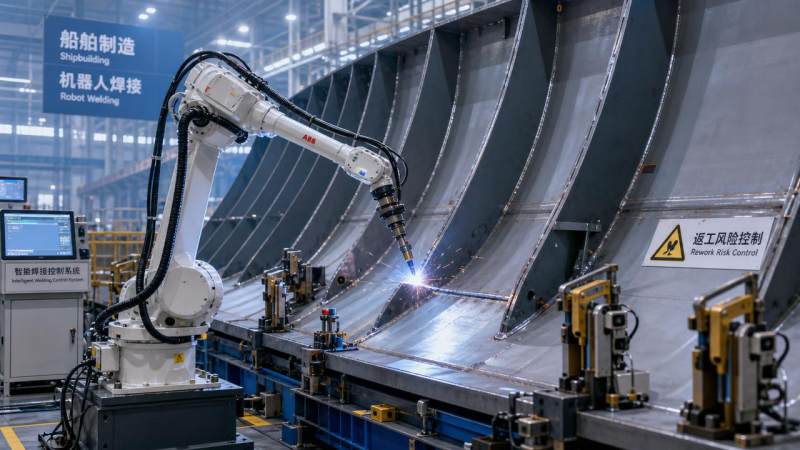
Choosing an industrial robotic welder oem for shipbuilding is not just about speed or price—it is about preventing costly rework that surfaces later in production, inspection, or sea-trial stages. For project managers and engineering leaders, understanding where weld automation fails helps reduce quality risks, protect schedules, and ensure every robotic welding investment delivers long-term shipyard performance.
Why project teams should use a checklist before selecting an OEM
In shipbuilding, rework rarely comes from a single visible mistake. It usually starts earlier: a welding robot that cannot maintain seam tracking on curved panels, a fixture concept that does not control distortion, software that cannot adapt to block variation, or an OEM that validates on simple coupons but not on real hull structures. That is why project leaders should assess an industrial robotic welder oem for shipbuilding with a checklist, not with marketing claims.
A structured review helps teams compare suppliers on the factors that actually drive downstream quality: process stability, metallurgical control, line integration, traceability, maintainability, and acceptance criteria. It also helps separate short-term CAPEX savings from total lifecycle cost. For shipyards working under schedule pressure, the wrong OEM decision can create hidden rework in panel lines, sub-assembly stations, outfitting interfaces, coating preparation, and class inspection documentation.
First-priority checks: what to confirm before technical discussions go too far
Before comparing torch reach, robot brand, or takt time, confirm these project-level basics. They determine whether an industrial robotic welder oem for shipbuilding can deliver a system that reduces rework instead of shifting it to later stages.
- Define weld families clearly. Separate fillet, butt, lap, stiffener, curved-section, and thick-plate applications. Rework risk increases when an OEM assumes one process window can cover all joint types.
- Map the real part variation. Ship structures are rarely identical. Plate fit-up gaps, edge prep quality, and block distortion must be measured and shared early.
- Identify inspection requirements. UT, RT, MT, VT, class rules, and internal quality thresholds affect robot programming, heat input, and data logging strategy.
- Clarify throughput versus repair tolerance. Some lines can accept a slower stable process; others cannot. If throughput targets are unrealistic, the system will be tuned toward speed and rework will rise later.
- Check integration boundaries. The OEM must fit existing PLC, MES, traceability, fixture control, consumable supply, and maintenance procedures.
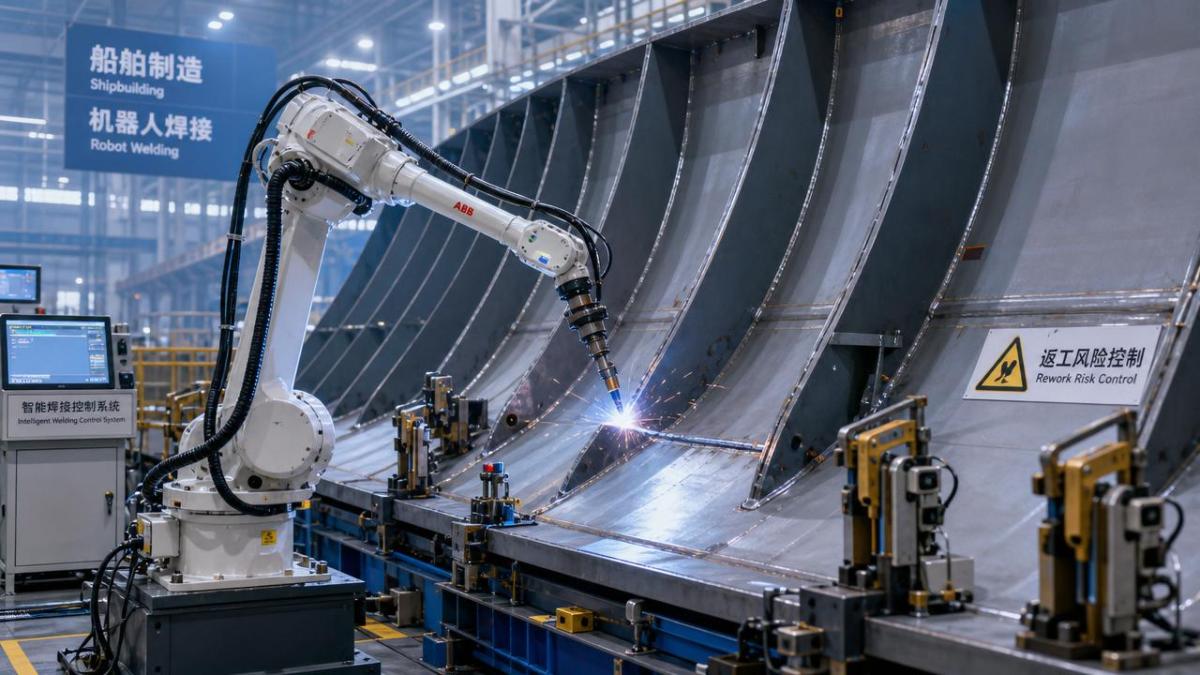
Core causes of later rework in shipbuilding robotic welding projects
1. Poor fit-up tolerance management
Many robotic systems perform well in demonstrations but fail in the yard because actual plate gaps and alignment variation exceed the programmed assumptions. If the OEM does not provide seam finding, adaptive control, gap compensation, and clear fixture tolerance limits, missed fusion, underfill, excess spatter, or unstable bead profile will appear later during inspection or assembly mating.
2. Incomplete distortion control strategy
Rework often appears after welding, not during it. A robot may produce visually acceptable welds while still causing panel warpage, angular distortion, or dimensional drift. A qualified industrial robotic welder oem for shipbuilding should link path planning, weld sequence, heat input, tack strategy, and fixture design into one distortion-control method.
3. Welding procedure validation that is too narrow
Some OEMs validate only on ideal specimens. In shipbuilding, procedures must reflect actual steel grades, thickness ranges, positional changes, environmental conditions, and joint accessibility. If PQR/WPS alignment is weak or qualification coverage is too limited, repairs show up when production parts move outside the tested envelope.
4. Software that is not robust enough for shipyard variability
Offline programming tools, digital twins, and sensor-driven path correction are valuable only if they handle frequent design changes and nonuniform geometry. Rework grows when operators must manually edit too many paths, override process parameters without governance, or restart jobs because the software cannot recover cleanly from real-world exceptions.
5. Weak consumable and parameter management
Contact tips, wire condition, gas shielding stability, torch cleaning cycles, and parameter libraries are often treated as minor issues. In practice, they are major rework drivers. A strong OEM should define parameter control logic, change management, alarm thresholds, and preventive maintenance intervals from the beginning.
Checklist: how to evaluate an industrial robotic welder oem for shipbuilding
Use the checklist below during RFQ, technical review, FAT planning, and acceptance discussions. These points help project managers compare suppliers on practical execution, not generic capability statements.
- Application evidence: Ask for installed references in shipbuilding or heavy fabricated structures with similar thickness, joint mix, and production rhythm.
- Process ownership: Confirm whether the OEM owns robot integration only, or also weld process development, fixtures, sensors, and acceptance support.
- Tolerance envelope: Require a documented statement of acceptable gap, mismatch, plate flatness, and positioning variation.
- Sensor strategy: Review laser seam tracking, through-arc sensing, vision alignment, and fallback logic when sensing fails.
- Distortion mitigation: Ask for sequence rules, clamping logic, heat input limits, and examples of dimensional control on large panels.
- Data traceability: Verify logging of weld ID, operator intervention, parameter changes, alarms, repair records, and quality correlations.
- Integration readiness: Check compatibility with PLC architecture, MES/ERP workflows, quality databases, and maintenance platforms.
- Service model: Evaluate spare parts lead time, remote diagnostics, local support depth, and escalation path for production stoppages.
A practical comparison table for decision makers
Scenario-based checks: what changes by shipyard context
For new line construction
When a shipyard is building a new automated welding line, the key risk is overestimating future standardization. The OEM should show how the system will ramp from stable baseline parts to more variable work packages. Commissioning plans, operator training, digital recipes, and staged acceptance metrics matter more than peak-speed promises.
For retrofit projects
Retrofit environments create hidden interface risks. Existing conveyors, manipulators, power quality, safety circuits, production IT, and legacy procedures may disrupt robotic welding consistency. In this case, an industrial robotic welder oem for shipbuilding should be evaluated heavily on integration experience and failure recovery methods.
For high-mix, low-repeat fabrication
If the yard builds varied vessel types or customized blocks, flexibility is the real KPI. Fast programming, reusable templates, operator-guided adjustments, and digital verification become more important than maximum arc-on time. Rework rises quickly when the system is optimized for repetitive work but deployed into variable production.
Commonly overlooked items that create expensive downstream repairs
Several issues are frequently missed during procurement but later become major repair drivers:
- Access constraints near stiffeners and complex corners. Simulations may not reflect actual torch clearance on real assemblies.
- Environmental variation. Temperature, humidity, dust, and plate condition influence arc stability and sensor reliability.
- Inspection loop delays. If quality findings are not fed back quickly into robot parameters, the same defect pattern repeats across many parts.
- Operator intervention rules. Without controlled permissions, manual edits can degrade a validated process over time.
- Consumable sourcing changes. A minor switch in wire or gas can alter weld behavior enough to trigger repair spikes.
Execution advice: how to reduce rework before PO and before FAT
The best way to control future repairs is to force clarity early. Project managers should ask the industrial robotic welder oem for shipbuilding to submit a measurable risk-control package, not just a technical proposal. That package should include representative sample validation, tolerance assumptions, acceptance criteria, traceability scope, maintenance requirements, and escalation ownership.
Before purchase order, prepare a shortlist of production parts that represent your hardest real conditions, not your easiest ones. Before factory acceptance test, define what constitutes pass or fail on weld appearance, penetration consistency, dimensional outcomes, and alarm recovery. Also require proof that software backups, parameter governance, and spare parts planning are complete. These steps do not slow the project; they prevent schedule loss from repeated repairs after installation.
Questions to raise in supplier discussions
To move from generic discussion to decision-grade evaluation, ask these direct questions:
- What production variation has your system already handled in comparable shipbuilding applications?
- Which defects are prevented by sensing, and which still depend on upstream fit-up discipline?
- How do you connect weld data to root-cause analysis when repairs appear weeks later?
- Which functions are standard, which are custom, and which require third-party coordination?
- What is your response plan if the line meets throughput but fails dimensional or inspection targets?
Final decision guidance for project leaders
For project managers, the best industrial robotic welder oem for shipbuilding is not the supplier with the fastest demo, but the one with the clearest control of variation, qualification, integration, and accountability. Rework later is usually a sign that early assumptions were incomplete. A disciplined checklist approach helps expose those gaps before they become production delays, repair labor, class issues, or sea-trial surprises.
If your team wants to move forward, prepare the following information first: target weld families, material and thickness ranges, expected fit-up variation, inspection standards, production takt, existing automation interfaces, maintenance capability, and budget boundaries. With those inputs, discussions about parameters, solution fit, implementation cycle, and cooperation model become far more reliable—and far less likely to result in expensive rework later.
Recommended News
- 2026/10/24Car Spare Parts: How to Check Fitment and Avoid Ordering the Wrong PartOrder car spare parts with confidence. Learn how to verify VINs, OEM numbers, and fitment details to avoid costly mistakes and choose the right replacement first time.
- 2026/10/23How Do You Select a Motion Control System for Synchronized Axes?How do I select a motion control system for synchronized axes? Discover key timing, feedback, and performance checks to choose confidently and reduce costly integration risks.
- 2026/10/23Integrating End-of-Line Sortation with Packing Stations and Conveyor ControlsOptimize end of line sortation with coordinated packing stations and conveyor controls. Learn how to prevent bottlenecks, improve routing accuracy, and handle exceptions reliably.