
Search News
Industry Portal
Popular Tags
What Sets a Reliable Industrial Robotics Manufacturer Apart?
Author
Dr. Victor Gear
Time
May 04, 2026
Pageviews
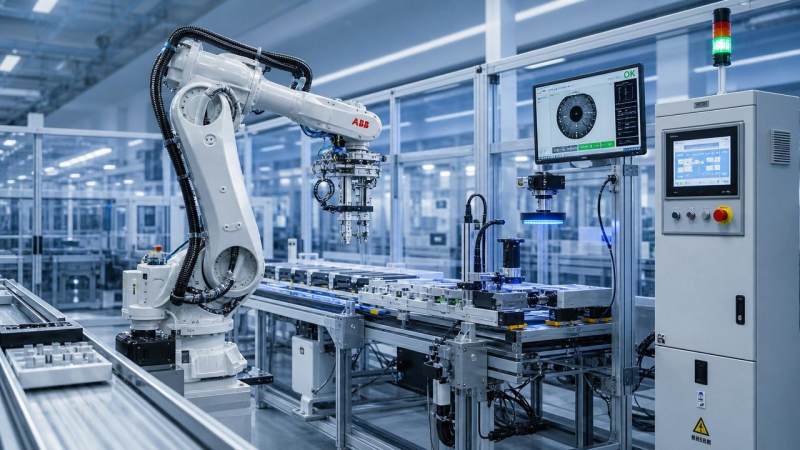
Choosing a reliable industrial robotics manufacturer is no longer just a procurement decision—it is a strategic move that affects productivity, compliance, and long-term automation ROI. For business evaluators comparing global suppliers, the real differentiators lie in engineering credibility, standards alignment, system integration capability, and data-backed performance that reduce operational risk across modern smart manufacturing environments.
Why does the choice of an industrial robotics manufacturer matter so much today?
In smart manufacturing, a robot is never just a standalone machine. It becomes part of a production architecture that may include PLC platforms, motion control systems, Industrial IoT software, safety logic, pneumatic tools, machine vision, and ERP or MES data flows. That is why selecting an industrial robotics manufacturer has become a high-impact business decision rather than a simple equipment comparison.
A reliable industrial robotics manufacturer helps reduce risk across the entire automation lifecycle: engineering design, commissioning, validation, operator training, maintenance, spare parts planning, and future line expansion. For business evaluators, this matters because hidden costs often emerge after purchase. A low initial quote can become expensive when integration is slow, documentation is incomplete, spare parts lead times are long, or software compatibility creates downtime.
The strongest manufacturers are not defined only by payload, reach, or cycle time. They stand out through measurable consistency: stable product quality, compliance with ISO, IEC, and CE expectations, strong application engineering, and transparent performance data. In other words, the best supplier supports not only machine movement, but also operational certainty.
What are the first signs that an industrial robotics manufacturer is truly reliable?
Business evaluators often ask what they should look for before they even begin technical due diligence. The answer usually starts with evidence. A dependable industrial robotics manufacturer should be able to demonstrate repeatable engineering capability rather than relying on broad marketing claims.
Key early indicators include:
- Documented compliance with international standards and safety requirements
- Clear performance specifications, including repeatability, duty cycle, and environmental limits
- Proven references in comparable industries, such as automotive, electronics, packaging, metalworking, or logistics
- Application engineering support for end-of-arm tooling, line integration, and process optimization
- Transparent service structure, including commissioning, training, remote diagnostics, and spare parts availability
Just as important, a reliable supplier will discuss limitations openly. If a manufacturer avoids detailed questions about takt time, integration constraints, software interoperability, or maintenance needs, that is a warning sign. Serious automation partners are willing to explain not only where their robots perform well, but also where another configuration may be better.
How can business evaluators compare manufacturers beyond price and specifications?
Price and headline specifications are useful, but they rarely reveal the full business case. A robust comparison framework should include operational fit, engineering maturity, and total cost of ownership. This is especially important when comparing a global industrial robotics manufacturer with a lower-cost regional alternative.
A practical way to compare suppliers is to score them across the factors that affect automation performance after installation. These include integration readiness, software ecosystem openness, diagnostics capability, local service response, and product lifecycle support. For example, a robot with strong payload performance may still underperform in a real production cell if its controller does not communicate smoothly with existing PLCs or factory software.
This evaluation model helps buyers move from feature comparison to decision quality. The right industrial robotics manufacturer should be able to answer commercial, technical, and operational questions with equal confidence.
Which engineering and compliance capabilities separate top manufacturers from average ones?
Engineering credibility is one of the clearest separators in the market. An average supplier can ship robots. A top industrial robotics manufacturer can engineer automation systems that perform reliably under real factory conditions, across shifts, operators, and product variations.
This often begins with mechanical and control quality. Durable gear design, servo precision, controller stability, thermal management, and cable routing all influence long-term reliability. But hardware alone is not enough. Modern factories depend on software intelligence, including diagnostics, condition monitoring, traceability, remote support, and integration with higher-level platforms.
Compliance capability is equally important. Manufacturers that work in international supply chains should understand machine safety, electromagnetic compatibility, documentation discipline, and validation procedures. They should also support integrators with risk assessments, functional safety coordination, and proper technical files where required. For business evaluators, this is not administrative detail; it directly affects deployment speed and legal exposure.
Another differentiator is benchmark transparency. High-quality suppliers can explain how their robots perform under defined conditions rather than quoting ideal laboratory values only. That includes payload derating at certain speeds, accuracy under continuous operation, and suitability for cleanroom, washdown, or harsh industrial settings when relevant.
How important is system integration capability when evaluating an industrial robotics manufacturer?
It is critical. In many projects, integration complexity causes more delay and cost than the robot itself. A manufacturer may produce excellent robotic arms, but if its controllers, communication protocols, safety architecture, or software tools are difficult to integrate, the project can quickly lose momentum.
A strong industrial robotics manufacturer understands that a robot must fit into a broader automation ecosystem. That includes compatibility with common PLC environments, fieldbus protocols, industrial Ethernet, SCADA interfaces, and data collection systems. It also includes practical issues such as cabinet design, wiring logic, simulation tools, and digital twins for process validation.
For business evaluators, the most useful questions are often cross-functional:
- Can the supplier support both robot hardware and application-level integration?
- Are there ready libraries or interfaces for mainstream control platforms?
- How is production data shared with MES, ERP, or IIoT systems?
- What is the plan for future expansion, line balancing, or redeployment?
Manufacturers with real integration maturity reduce the burden on the buyer, the integrator, and the production team at the same time. That is especially valuable when timelines are tight or when internal engineering resources are limited.
What common mistakes do buyers make when selecting an industrial robotics manufacturer?
One common mistake is focusing too heavily on capital expenditure while underestimating operational cost. A cheaper robot may require more custom integration, more training time, or more frequent service intervention. Over several years, that can erase the initial savings.
Another mistake is evaluating robots outside their intended application context. For example, a robot suited for repetitive pick-and-place may not be ideal for force-sensitive assembly, vision-guided handling, or multi-product manufacturing. A reliable industrial robotics manufacturer will ask detailed process questions before recommending a model, because fit matters more than brochure rankings.
Buyers also sometimes overlook service infrastructure. Global manufacturing operations need dependable technical support, spare parts continuity, and clear escalation paths. A manufacturer with strong engineering but weak after-sales support can still create substantial business risk.
Finally, some teams assume that compliance and cybersecurity can be solved later. In reality, these issues should be addressed early, especially when robots are connected to production networks or used in regulated environments. If an industrial robotics manufacturer cannot provide clear answers on data interfaces, software updates, access control, and safety validation, that gap should be treated seriously.
What should companies confirm before moving forward with procurement or partnership discussions?
Before issuing a final RFQ or committing to a supplier shortlist, business evaluators should clarify the questions that most affect project success. The goal is not only to verify equipment capability, but to confirm delivery confidence, implementation quality, and long-term support.
Priority confirmation points include application scope, expected takt time, payload and reach margins, safety concept, controller compatibility, software licensing, training requirements, installation timeline, acceptance criteria, and warranty coverage. It is also wise to ask whether the industrial robotics manufacturer can support proof-of-concept testing, simulation, or sample validation before full deployment.
For global buyers, regional support structure matters as much as factory capability. Confirm who will handle commissioning, whether documentation is localized, how quickly replacement parts can be delivered, and what remote troubleshooting tools are available. In high-uptime sectors, these practical details can influence vendor selection more than a small variation in price.
A reliable industrial robotics manufacturer should welcome this level of scrutiny. The more transparent the conversation is at the start, the lower the risk of conflict, delay, or performance mismatch later.
How can you tell if a manufacturer is the right fit for long-term smart factory goals?
The right fit is not always the biggest brand or the lowest-cost offer. It is the industrial robotics manufacturer whose capabilities align with your production model, digital maturity, compliance obligations, and expansion roadmap. That means looking at both present needs and future flexibility.
For companies moving toward Industry 4.0, long-term value comes from suppliers that understand both hardware precision and software intelligence. They should be able to support data-driven maintenance, production traceability, system interoperability, and scalable automation across multiple plants or product lines. In this environment, robotics is part of a broader intelligent factory strategy, not an isolated purchase.
If you need to confirm a specific solution, technical direction, implementation cycle, quotation logic, or cooperation model, start by asking practical questions: What benchmark data supports the proposal? Which standards are covered? How will this integrate with existing control and software infrastructure? What service response can be guaranteed after startup? Those answers will quickly reveal whether an industrial robotics manufacturer is built for dependable partnership or just for equipment supply.
Recommended News
- 2026/05/07Remote I O module wholesale: how much redundancy is enough?Remote I/O module wholesale: learn how much redundancy is enough to protect uptime, control costs, and improve reliability with practical procurement guidance.
- 2026/05/07Open source PLC trends are changing small-line automation choicesOpen source PLC trends are reshaping small-line automation with lower lock-in, faster integration, and scalable control choices. Discover what buyers should evaluate before upgrading.
- 2026/05/07What VFD suppliers rarely mention about motor heat and tuningvfd variable frequency drive supplier insights on hidden motor heat, poor tuning, and low-speed load risks—learn practical checks to prevent failures and extend motor life.