
Search News
Industry Portal
Popular Tags
Why SCARA robots still win in fast automotive assembly cells
Author
Dr. Victor Gear
Time
May 06, 2026
Pageviews
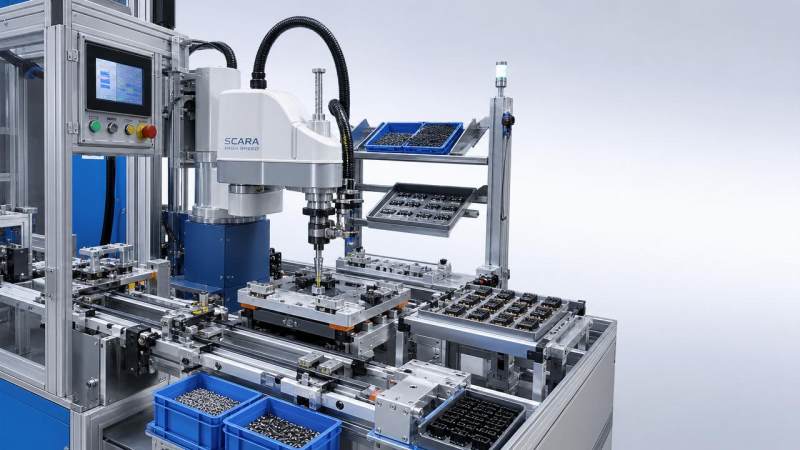
In high-volume vehicle production, speed, repeatability, and compact cell design still matter most. That is why the scara robot factory for automotive assembly remains a practical choice for operators and line planners who need fast cycle times, stable horizontal motion, and easy integration. Even as flexible robot options expand, SCARA systems continue to deliver reliable performance where precision handling and nonstop throughput directly shape assembly efficiency.
For users and operators, the key question is not whether SCARA robots are newer or more advanced than every alternative. The real question is simpler: in which automotive assembly tasks do they still outperform other robot types in daily production? In many fast cells, the answer remains clear. When the job involves short reaches, repeated pick-and-place, pressing, screwdriving, dispensing, connector insertion, or precise component transfer, SCARA robots still offer a strong mix of speed, footprint efficiency, and process stability.
This matters because assembly performance is decided on the line, not in a brochure. Operators care about whether the robot hits cycle time without constant tuning, whether changeovers are manageable, whether faults are easy to diagnose, and whether the system keeps delivering repeatable motion across long shifts. In those practical areas, SCARA robots continue to justify their place in automotive manufacturing.
Why do SCARA robots still make sense in fast automotive assembly cells?
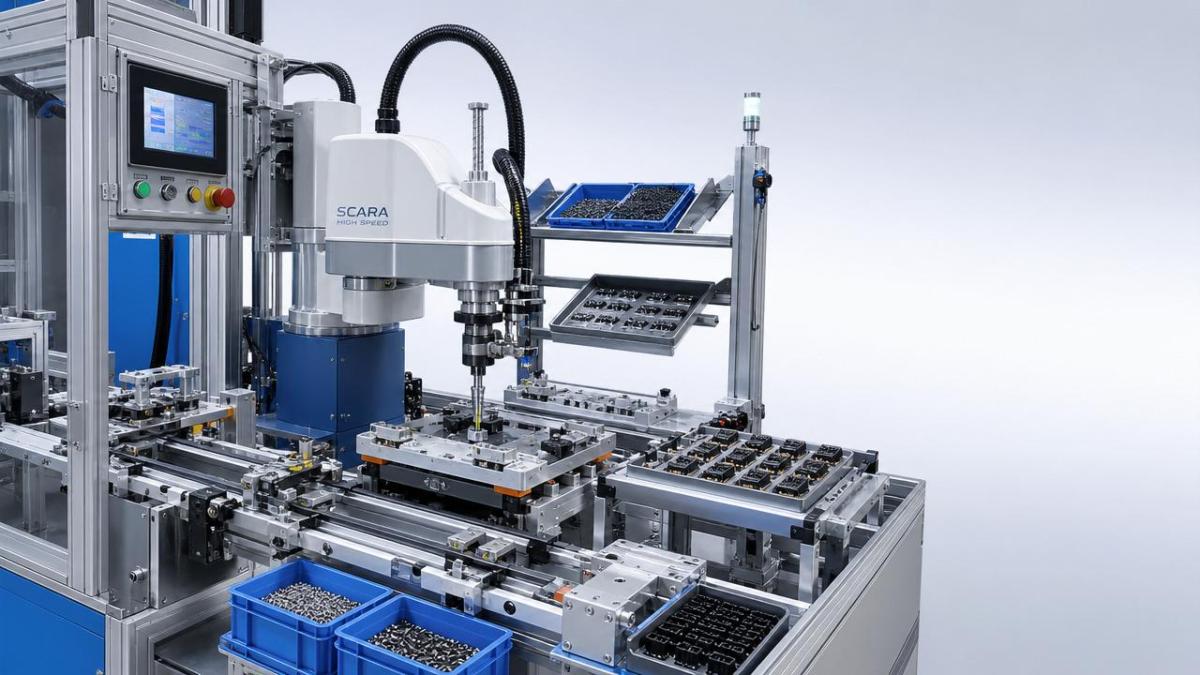
The biggest reason is motion efficiency. A SCARA robot is designed for high-speed movement in the horizontal plane with strong repeatability and low wasted motion. In automotive assembly cells, many tasks happen within a limited working envelope: pick a part, move laterally, place it, press it, or align it. That motion pattern fits SCARA kinematics extremely well.
Compared with larger 6-axis robots, SCARA systems usually require less path complexity for short, repetitive moves. They accelerate quickly, settle fast, and maintain accuracy in applications where line takt time is tight. In practice, that can mean smoother part flow, fewer micro-stoppages caused by positioning issues, and better consistency from shift to shift.
Another reason is compact integration. Automotive plants are under constant pressure to fit more function into less floor space. A SCARA robot often allows a cell to remain smaller and simpler, especially where components enter on feeders, trays, or conveyors and exit into fixtures or subassemblies. For operators, a compact cell can also improve visibility, access for routine service, and cleaner task zoning around the station.
The keyword here is fit. A scara robot factory for automotive assembly does not win by replacing every robot category. It wins by matching the right robot structure to the right task. When the process is fast, repetitive, and mostly planar, SCARA remains one of the most efficient tools available.
What automotive assembly tasks are best suited to SCARA robots?
SCARA robots remain especially valuable in subassembly and component handling steps where speed and placement stability matter more than broad orientation freedom. Common examples include electronic module handling, sensor placement, relay or fuse box assembly, connector insertion, clip loading, adhesive dispensing, screw tightening, and transfer of small metal or plastic parts between fixtures.
They are also well suited to EV-related assembly support tasks. Battery-related production involves many repetitive motions around small parts, housings, busbars, connectors, and inspection handoffs. Not every battery or e-mobility operation needs a 6-axis arm. In feeder-to-fixture, tray-to-nest, or station-to-station transfers, SCARA systems can still be the more productive option.
Operators often see the benefit in tasks that require consistent vertical compliance or controlled insertion after fast horizontal travel. This is where SCARA robots can be highly effective for press-fit actions, terminal insertion, and locating parts into guides or nests. The robot is not overbuilt for the task, so the system can be easier to tune for stable cycle behavior.
However, SCARA is not the best answer for every process. If the application requires complex wrist orientation, deep reach into 3D spaces, obstacle avoidance, or multiple angular approaches to a part, a 6-axis robot may be the better fit. The value of SCARA becomes strongest when the process window is narrow, repetitive, and optimized for output.
Why do operators often prefer SCARA cells in daily production?
From an operator perspective, simplicity is a major advantage. A good SCARA cell often has fewer motion variables than a more complex robot cell. That can translate into easier teaching, more intuitive troubleshooting, and faster recovery after interruptions. When a station stops during production, the line team needs a clear path back to normal operation. Simpler motion logic helps.
Cycle time consistency is another practical benefit. In automotive assembly, peak speed matters, but repeatable speed matters more. A robot that occasionally slows due to path complexity, overshoot correction, or unstable gripping can create bottlenecks. SCARA robots are often chosen because they deliver predictable motion over very high repetition counts.
Maintenance can also be more straightforward. Many SCARA installations have smaller working envelopes, simpler guarding layouts, and easier access to tooling, feeders, and fixtures. For operators and technicians, this reduces the time needed for visual checks, minor adjustments, or replacement of wear components. Better accessibility supports uptime.
There is also less risk of overengineering. In some automotive cells, companies install more robot flexibility than the process actually needs. That may look future-ready, but it can add programming burden, footprint pressure, and unnecessary cost. A SCARA robot, when matched correctly to the task, keeps the cell focused on throughput and stability rather than unused capability.
How does SCARA performance compare with 6-axis robots in high-speed cells?
The comparison should be based on application reality, not general assumptions. A 6-axis robot is more flexible in orientation and reach, but that flexibility comes with more complex motion control. For tasks that require only limited angular variation and short transfer paths, a SCARA robot often completes the move faster and with less path management overhead.
This does not mean SCARA is “better” in every technical category. It means its strengths align with certain assembly requirements. In high-speed automotive cells, the goal is often to reduce non-value-added motion. If the part only needs to move from A to B with precise placement and light vertical action, extra axes may not improve output. They may simply add mechanical and programming complexity.
SCARA robots also tend to support tighter cell packaging. A compact footprint reduces travel distance between feeders, nests, and fixtures. Shorter distances can improve cycle time and reduce the chance of cumulative alignment drift in handling processes. In many cases, cell layout contributes as much to productivity as robot model selection.
Where 6-axis robots win is in multi-angle assembly, access around obstructions, varied product handling, and future task changes that demand more orientation freedom. So the better question for a line planner or operator is not “Which robot is more advanced?” but “Which robot creates the most reliable output for this station?” In many fast automotive assembly cells, SCARA still wins that test.
What should users check before choosing a SCARA robot factory for automotive assembly?
First, confirm the motion profile of the real task. Map the actual pick points, place points, insertion depth, required orientation, payload, and cycle target. If most of the movement is horizontal with limited rotational complexity, SCARA is a strong candidate. If the process needs high wrist articulation or irregular 3D paths, another robot type may be safer.
Second, examine tooling and part presentation. The best SCARA robot will still underperform if feeders, nests, grippers, or vision systems introduce instability. Automotive assembly performance depends on the entire cell. Users should check whether the gripper supports reliable part pickup, whether fixture tolerance is controlled, and whether the robot can recover cleanly from mispicks or part absence signals.
Third, look at integration quality. A true scara robot factory for automotive assembly should not only supply the arm. It should support controls compatibility, safety architecture, communication with PLC systems, traceability needs, and practical maintenance access. For production users, integration quality often has a larger impact on uptime than small differences in robot speed specifications.
Fourth, review serviceability and spare part planning. Fast automotive lines cannot afford long recovery delays. Users should ask how quickly common components can be replaced, how diagnostic messages are presented, and whether local technical support is available. A robot that is fast on paper but difficult to maintain under plant conditions can become a hidden bottleneck.
What common concerns keep teams from using SCARA robots, and are they valid?
One common concern is lack of flexibility. This concern is valid only when the process actually requires more degrees of freedom. If a product family is stable and the station performs a narrow set of repeated actions, SCARA is not a limitation. In fact, its specialization is often the reason for better throughput.
Another concern is whether SCARA robots can keep up with modern automotive product variation. The answer depends on how variation enters the cell. If variants differ mainly in part size, fixture position, or recipe parameters within a structured layout, SCARA systems can still handle the job well. Recipe-driven adjustments, vision guidance, and modular EOAT designs can provide enough flexibility without moving to a more complex robot architecture.
Some teams also worry about durability in nonstop production. This is a reasonable concern, but it should be evaluated through duty cycle, maintenance intervals, payload margin, and actual installed base performance. A properly specified SCARA robot is built for repetitive industrial work. Problems usually come from overspeeding, poor payload matching, unstable tooling, or weak integration rather than from the robot concept itself.
There is also a perception that SCARA is an older solution. In reality, maturity can be an advantage. Proven motion behavior, broad integration experience, and well-understood maintenance requirements are valuable in automotive manufacturing. Plants do not need novelty for its own sake. They need repeatable output, manageable risk, and reliable support.
How can operators and line planners get the most value from SCARA-based cells?
Start by optimizing the whole station around the robot’s strengths. Keep part presentation consistent, reduce unnecessary robot travel, and place fixtures to support direct horizontal movement. Even a high-performance robot loses its advantage if the cell layout forces awkward transfers or frequent alignment corrections.
Standardize recovery procedures. Operators benefit when common faults such as empty feeder pockets, part misalignment, vacuum loss, or sensor timeout have clear restart steps. A SCARA cell can deliver excellent uptime, but only if the operating team can recover quickly without waiting for advanced programming support on every interruption.
Use data, not assumptions. Track cycle time variation, failed picks, insertion force alarms, feeder stoppages, and maintenance interventions. This helps separate robot-related issues from upstream and downstream constraints. In many cases, what appears to be a robot limitation is actually a tooling or part presentation problem.
Finally, think in terms of station economics. If a SCARA robot can meet takt, hold repeatability, reduce footprint, and simplify operation, it may provide better real value than a more flexible but more complex solution. In automotive assembly, winning cells are not chosen by maximum theoretical capability. They are chosen by stable output per square meter, per shift, and per maintenance hour.
Conclusion: SCARA still wins where speed, repeatability, and layout efficiency matter most
SCARA robots continue to earn their place in automotive assembly because many production tasks still reward exactly what they do best: fast horizontal movement, precise repeatability, compact integration, and stable operation over long runs. For users and operators, that translates into easier station control, predictable cycle time, and practical uptime advantages.
A scara robot factory for automotive assembly is most valuable when the process is repetitive, high-volume, and structurally suited to planar motion. In those conditions, SCARA is not an outdated compromise. It is often the most efficient and lowest-risk choice. The smartest selection is not about following trends. It is about matching robot architecture to real production needs.
If your assembly station depends on short, precise, nonstop moves rather than complex multi-angle motion, SCARA remains a serious benchmark solution. In fast automotive cells, it still wins for one simple reason: it keeps output high without adding complexity the process does not need.
Recommended News
- 2026/10/24Car Spare Parts: How to Check Fitment and Avoid Ordering the Wrong PartOrder car spare parts with confidence. Learn how to verify VINs, OEM numbers, and fitment details to avoid costly mistakes and choose the right replacement first time.
- 2026/10/23How Do You Select a Motion Control System for Synchronized Axes?How do I select a motion control system for synchronized axes? Discover key timing, feedback, and performance checks to choose confidently and reduce costly integration risks.
- 2026/10/23Integrating End-of-Line Sortation with Packing Stations and Conveyor ControlsOptimize end of line sortation with coordinated packing stations and conveyor controls. Learn how to prevent bottlenecks, improve routing accuracy, and handle exceptions reliably.