
Search News
Industry Portal
Popular Tags
How industrial IoT for predictive maintenance cuts downtime
Author
Lina Cloud
Time
May 27, 2026
Pageviews

For enterprise decision-makers under pressure to improve uptime and control maintenance costs, industrial IoT for predictive maintenance offers a measurable path to smarter operations. By turning machine data into early fault insights, manufacturers can reduce unplanned downtime, extend asset life, and make more confident investment decisions across increasingly automated production environments.
Why industrial IoT for predictive maintenance needs a checklist approach
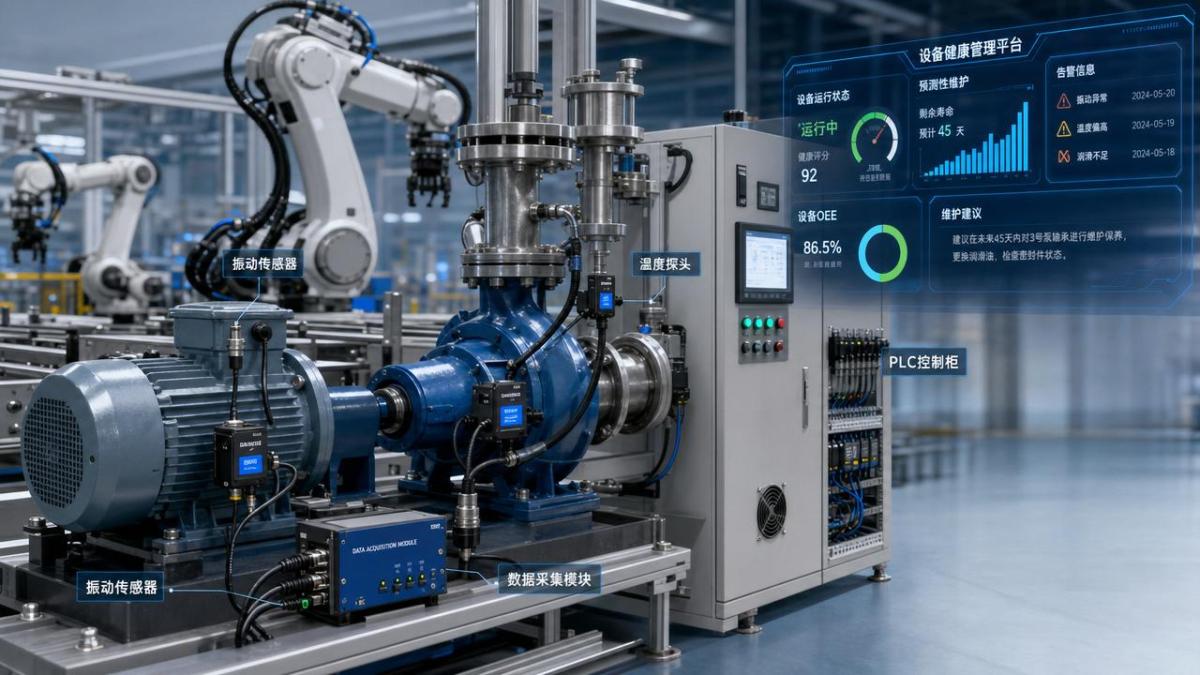
Industrial IoT for predictive maintenance is not just about adding sensors. It requires a disciplined method for selecting assets, validating signals, and connecting maintenance actions to measurable production outcomes.
In mixed production environments, failure modes vary across robotics, PLC-controlled equipment, drives, compressors, pumps, and hydraulic units. A checklist helps standardize decisions before cost, complexity, and data noise undermine return on investment.
This matters across comprehensive industries because downtime rarely stays local. One unstable motor, gearbox, or controller can ripple through quality, scheduling, labor use, spare parts demand, and customer delivery performance.
Core checklist for deploying industrial IoT for predictive maintenance
- Prioritize critical assets by downtime cost, safety exposure, bottleneck position, and replacement lead time before selecting sensors or analytics tools.
- Map failure modes first, then match vibration, temperature, current, pressure, oil, and cycle-count signals to each likely fault mechanism.
- Verify data quality at the edge by checking sampling rate, sensor placement, calibration drift, timestamp accuracy, and communications stability.
- Connect machine data to operating context, including load, speed, product mix, ambient conditions, and maintenance history.
- Define alert thresholds using baseline behavior and engineering limits, not generic vendor defaults that trigger excessive false alarms.
- Integrate industrial IoT for predictive maintenance with CMMS, MES, ERP, or SCADA so insights become work orders and planned interventions.
- Measure business impact through mean time between failures, unplanned downtime hours, spare parts consumption, and maintenance labor efficiency.
- Secure the architecture with network segmentation, device authentication, access control, and patch governance aligned with industrial cybersecurity practices.
- Pilot on a narrow but high-value line, validate prediction accuracy, then scale standards across similar equipment families.
- Assign ownership across engineering, maintenance, operations, and IT so no alert remains technically visible but operationally ignored.
When these steps are followed, industrial IoT for predictive maintenance becomes an operational system rather than a dashboard project. The difference is execution discipline, not just technology selection.
What to monitor across common industrial assets
Rotating equipment
Motors, pumps, fans, and gearboxes often produce early warning signals well before breakdown. Vibration spectrum changes, bearing temperature rise, and current imbalance are common indicators.
Industrial IoT for predictive maintenance is especially effective here because failure progression is often detectable. The key is correlating signals with speed, load, lubrication condition, and duty cycle.
Robotics and motion systems
Servo motors, reducers, ball screws, and linear guides can drift gradually before performance loss becomes visible. Monitor torque patterns, positioning deviations, thermal trends, and cycle counts.
For automated cells, predictive signals should be linked to takt time and repeatability. Small motion anomalies can grow into scrap, collision risk, or line stoppage if left unaddressed.
Pneumatic and hydraulic systems
Leaks, contamination, pressure instability, and valve wear often drive hidden energy and reliability losses. Track pressure decay, compressor cycling, oil cleanliness, and actuator response times.
In these systems, industrial IoT for predictive maintenance supports both uptime and energy efficiency. That dual value can strengthen the business case faster than downtime reduction alone.
PLC and control environments
Not every issue starts with a bearing. Controller faults, network latency, I/O instability, and thermal stress inside cabinets can also trigger process interruptions.
Monitor cabinet temperature, power quality, communication error rates, and abnormal stop events. These digital indicators are often overlooked in predictive maintenance programs focused only on mechanics.
Commonly overlooked risks in industrial IoT for predictive maintenance
Ignoring failure economics is a frequent mistake. Some assets are easy to monitor but contribute little financial value. Prioritize assets where prediction changes real maintenance timing and production risk.
Assuming more data means better prediction is another trap. Poor sensor placement, unstable gateways, and missing context can produce misleading outputs and unnecessary maintenance actions.
Separating analytics from maintenance workflows limits impact. If alerts do not trigger inspection steps, parts planning, and documented closeout, the program stalls at visibility without intervention.
Overlooking standards and interoperability creates long-term friction. Equipment from multiple vendors should align with practical data models, secure protocols, and recognized industrial compliance expectations.
Underestimating cybersecurity risk can stop expansion. Every sensor, edge device, and cloud connection increases the attack surface, especially when remote diagnostics and third-party access are involved.
Practical execution steps that improve results
- Start with one failure mode per asset class, such as bearing wear or overheating, and prove detection reliability before adding broader models.
- Use historian, SCADA, or MES data already available before installing new hardware, then close clear signal gaps with targeted instrumentation.
- Build a review cadence that compares alerts against actual inspections, root causes, and maintenance outcomes every month.
- Set response rules for alert severity, required verification steps, and escalation timing to avoid inconsistent maintenance decisions.
- Document baseline machine signatures after overhaul, alignment, or commissioning so future anomalies can be evaluated against verified healthy conditions.
A strong program also benefits from benchmark thinking. Comparing component behavior, automation architecture, and compliance readiness against international engineering standards improves technology confidence and scaling discipline.
That is where a technical reference framework adds value. Cross-sector evaluation of robotics, controls, motion systems, industrial software, and fluid power helps separate credible predictive maintenance strategies from marketing claims.
Conclusion and next action
Industrial IoT for predictive maintenance cuts downtime when it is anchored in asset criticality, data quality, workflow integration, and measurable business outcomes. The goal is not more alarms. The goal is fewer surprises.
The most effective next step is a structured audit of one critical line. Identify top failure modes, confirm available data sources, define intervention thresholds, and connect alerts to maintenance execution.
With that foundation, industrial IoT for predictive maintenance can scale from isolated monitoring to a reliable operating model that supports uptime, asset longevity, and better capital planning across modern automated facilities.
Recommended News
- 2026/07/12Technical Selection Support for IEC Standards: How to Match Components to Compliance NeedsTechnical selection support IEC standards helps match relays, drives, sensors, and PLCs to real compliance needs, reducing audit risk, delays, and costly redesigns.
- 2026/07/12Automation Sourcing Risk Analysis: 7 Supplier Risks That Delay Industrial ProjectsAutomation sourcing risk analysis reveals 7 supplier risks that delay industrial projects, from lead times to compliance and support—learn practical ways to reduce delays and protect delivery.
- 2026/07/12Wearable Medical Devices: Key Types, Core Sensors, and Where Each One Fits BestWearable medical devices explained: discover key types, core sensors, and best-fit use cases to choose smarter monitoring solutions with confidence.