
Search News
Industry Portal
Popular Tags
Heavy Duty Industrial Equipment: Buy New or Customize
Author
Dr. Victor Gear
Time
Apr 26, 2026
Pageviews
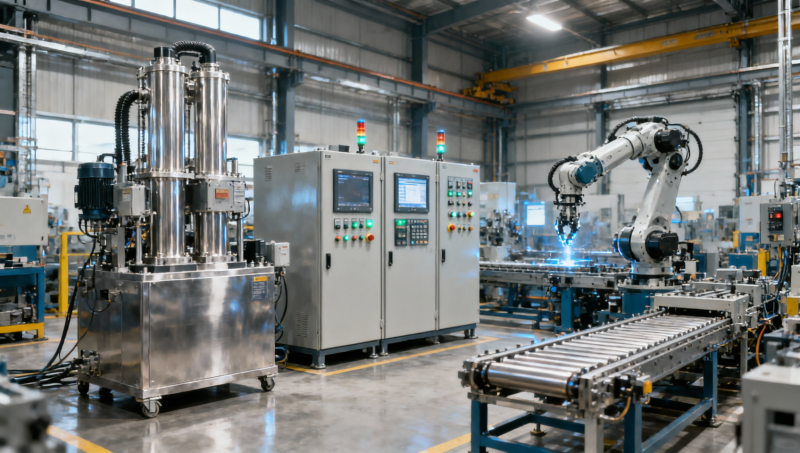
When sourcing heavy duty industrial equipment, should you buy new or customize for your production goals? From industrial IoT solutions and MES software sourcing to hydraulic systems custom and control systems OEM, the right choice affects performance, uptime, and industrial equipment price. This guide helps procurement teams, operators, and decision-makers evaluate smart manufacturing benefits with clarity and lower risk.
For modern factories, the decision is rarely limited to a single machine. It often includes robotic cells, PLC and control systems, motion platforms, hydraulic power units, sensors, edge gateways, and software layers such as MES or ERP integration. A standard off-the-shelf unit may offer faster delivery and easier commissioning, while a customized solution can improve cycle time, fit constrained layouts, and reduce long-term operating cost.
G-IFA supports this decision with cross-sector benchmarking across robotics, control, motion, industrial software, and fluid power. For buyers comparing a new standard asset against a tailored industrial equipment package, the practical question is not only price. It is also about lifecycle value, technical fit, compliance, scalability, and risk control over the next 3 to 10 years.
What “Buy New” and “Customize” Really Mean in Heavy Duty Industrial Equipment
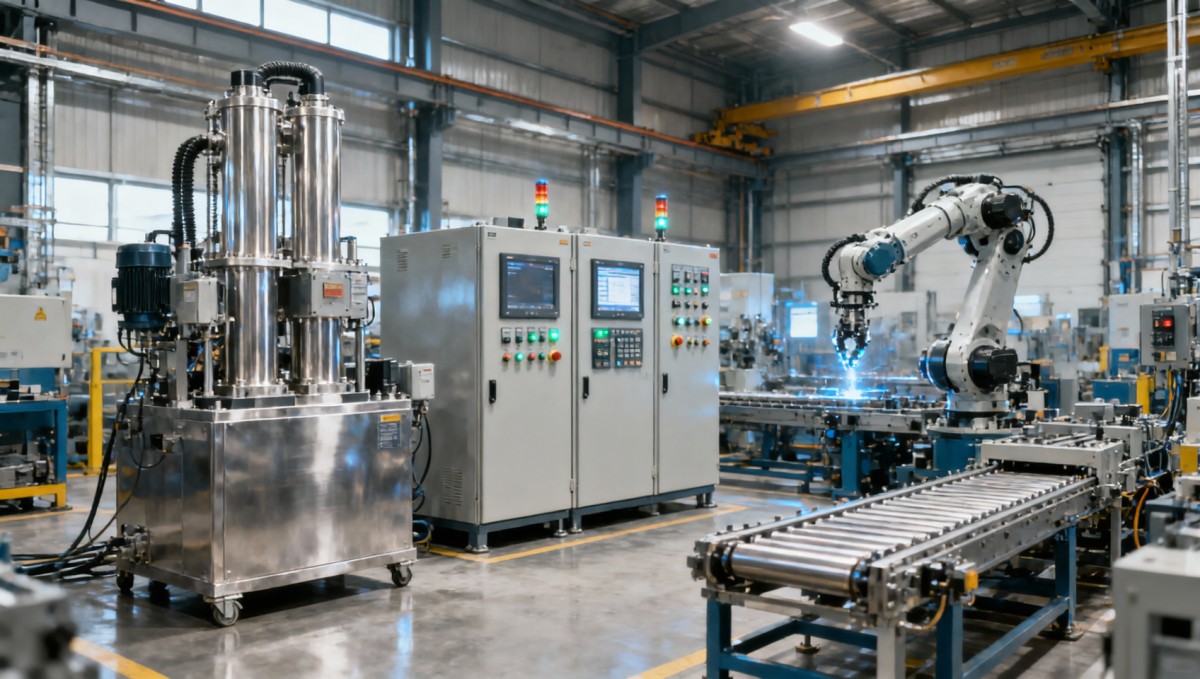
In industrial procurement, buying new usually refers to selecting a standard machine, system, or module with defined specifications, tested performance windows, and a known support model. Typical examples include standard servo presses, conveyors, hydraulic stations, PLC cabinets, AGV-compatible drive units, or preconfigured MES software licenses. These products often arrive with lead times of 2 to 8 weeks, depending on stock, power class, and required compliance documents.
Customization, by contrast, ranges from light engineering changes to full OEM development. A buyer may request special payload handling, non-standard dimensions, IP65 or IP67 protection, communication protocol changes such as PROFINET or EtherCAT, or software modifications for recipe management, OEE dashboards, and traceability. In heavy duty industrial equipment, even a small design change can affect frame strength, thermal behavior, hydraulic pressure stability, and maintenance access.
The choice matters because factory conditions are rarely generic. One line may run 16 hours per day with 20 product changeovers per week, while another may process high-load materials under dust, oil mist, or vibration. Standard equipment performs well when the application stays within validated limits. Custom equipment becomes valuable when installation constraints, process tolerances, or integration requirements exceed those limits.
A practical decision starts by separating must-have requirements from nice-to-have features. If a plant needs a 5-ton handling structure, ±0.2 mm repeatability in a guided station, and PLC interoperability with an existing line built 6 years ago, the buyer should map each requirement to engineering complexity and business impact before requesting quotations.
Typical boundaries between standard and custom scope
Many projects are not fully standard or fully bespoke. They fall into a hybrid model. A standard mechanical platform can be paired with custom guarding, custom HMI logic, or customized data exchange for MES and ERP. This often lowers technical risk while keeping deployment time within 4 to 10 weeks instead of a longer 12 to 20-week engineered build.
- Standard new equipment: fixed payload, standard voltage, predefined controls, standard interface options.
- Configured equipment: standard base machine with optional drives, sensors, communication cards, or software modules.
- Custom equipment: modified mechanics, custom hydraulic circuits, custom controls, and project-specific software logic.
- OEM-level development: unique machine architecture, site-specific compliance review, FAT and SAT planning, and lifecycle support terms.
The table below helps clarify how these procurement paths differ in terms of speed, engineering burden, and operational fit.
The key conclusion is simple: standard equipment reduces schedule pressure, while customized equipment reduces process mismatch. In many smart manufacturing projects, the right answer is a controlled combination of both.
How to Evaluate Cost, Uptime, and Lifecycle Risk
Industrial equipment price is only one layer of total cost. A lower purchase price can become more expensive if it causes 4 hours of downtime per month, requires frequent manual workarounds, or cannot exchange data with MES and supervisory systems. Decision-makers should compare at least 5 cost layers: capital expense, installation, integration, maintenance, and productivity impact.
For example, a standard hydraulic unit may cost less upfront, but if it is oversized by 20% to 30% for the actual load profile, it may waste energy and run hotter than necessary. On the software side, an MES package with low entry cost may still need custom connectors, tag mapping, user-role design, and dashboard configuration. These engineering items often determine the true project budget.
Uptime should be measured through serviceability as much as through nominal performance. Maintenance teams usually benefit from standard spare parts, common PLC libraries, and clear alarm structures. However, operators benefit from customized ergonomics, safer access zones, and application-specific HMI screens that reduce setup error. Plants with fewer than 3 maintenance specialists per shift often prefer architectures that simplify troubleshooting within 15 to 30 minutes.
A balanced review therefore links engineering fit to operational resilience. If a line has high hourly output value, even a 1% to 2% increase in uptime can justify controlled customization. If the application is repetitive, low-variation, and already proven in similar sites, a standard new unit may generate the strongest return.
A practical total-cost review model
Before issuing a purchase order, teams can score each option against commercial and operational criteria. This matrix is especially useful when comparing robotics cells, motion assemblies, control cabinets, industrial IoT gateways, or hydraulic systems custom projects.
If the production process is stable for the next 24 to 36 months, standard equipment often wins. If demand volatility, product variety, or digital traceability requirements are increasing, customization may produce better long-term economics despite a higher upfront figure.
Four cost traps buyers should avoid
- Comparing base machine price without including installation, cabling, software setup, and validation.
- Ignoring spare part standardization across sites, which can increase stock complexity by 2x or more.
- Over-customizing low-value functions that operators can manage through simpler fixtures or procedures.
- Under-specifying data integration, then paying for urgent software rework after commissioning.
When Customization Creates the Most Value in Smart Manufacturing
Not every factory needs a custom build, but several conditions strongly favor it. One is footprint restriction. Brownfield plants often have limited aisle space, legacy utilities, or non-standard floor loading. Another is process complexity, especially where robotics, vision, motion control, and hydraulic actuation must work in a coordinated sequence under strict tolerance limits.
Customization also makes sense when software and hardware must behave as one system. A factory introducing industrial IoT solutions may need machine data from 50 to 500 tags per asset, alarm history retention, role-based access, and ERP synchronization for work orders or batch records. In these cases, software fit can be as important as mechanical fit. An off-the-shelf machine with poor data structure can become an obstacle to digital transformation.
Heavy duty applications frequently require custom engineering for load safety and durability. Examples include lifting frames above 2 tons, shock loads, variable-speed drives under high inertia, or hydraulic pressure ranges above standard package assumptions. Here, engineering should review frame stress, actuator sizing, thermal dissipation, duty cycle, and protective logic, rather than relying only on catalog values.
Another high-value case is control systems OEM work for multi-vendor plants. If a site already uses a preferred PLC family, SCADA structure, and safety architecture, a custom control package reduces training burden and improves fault response. Operators and electricians can usually restore production faster when the new equipment uses familiar logic, naming conventions, and maintenance procedures.
High-return customization scenarios
- Special environment requirements such as dust, washdown, heat, or oil contamination that demand higher sealing and cable protection.
- Integration with existing MES, ERP, PLC, and historian platforms where standard drivers are not enough.
- Process lines with more than 10 product variants, frequent changeovers, or recipe-driven production logic.
- Safety upgrades where guarding, interlocks, and emergency stop zoning must fit an existing layout.
- Hydraulic systems custom projects needing pressure, flow, filtration, and manifold design tuned to real duty cycles.
The main caution is governance. Customization works best when scope control is strong. Every requested change should be linked to one of four outcomes: improved safety, reduced downtime, increased throughput, or better data visibility. If a change cannot be tied to one of these outcomes, it may not deserve engineering budget.
Specification checklist before requesting a custom quote
A well-prepared RFQ shortens clarification cycles and improves quotation quality. For most projects, buyers should define at least 8 to 12 technical points before supplier engagement.
- Required throughput, cycle time, and target OEE.
- Payload, force, torque, pressure, or speed range.
- Utility conditions such as voltage, air quality, hydraulic fluid, and ambient temperature.
- Preferred PLC, HMI, fieldbus, and data protocol.
- Compliance needs including ISO, IEC, CE, and site safety rules.
- Maintenance access, spare parts strategy, and training expectations.
- FAT, SAT, and commissioning acceptance criteria.
- Required documentation set, from wiring drawings to software backup files.
A Decision Framework for Procurement Teams, Operators, and Executives
Different stakeholders judge equipment differently. Procurement focuses on commercial risk, lead time, and supplier responsiveness. Operators care about usability, changeover, and fault clarity. Executives look at output stability, capacity growth, and capital efficiency. The strongest equipment decision aligns all three views early, ideally before final technical sign-off.
A useful method is to run a 3-layer review. Layer one covers application fit: load, speed, environment, and layout. Layer two covers integration fit: controls, software, data, safety, and maintenance. Layer three covers business fit: budget, payback window, spare strategy, and supplier support. If one option scores high in only one layer, it is usually not the right investment.
For heavy duty industrial equipment, teams should also decide how much future flexibility is needed. If product geometry may change within 12 months, if another line may be added within 24 months, or if traceability requirements are tightening, standard equipment with no expansion path can become restrictive. A modular custom solution may offer better capital protection even if delivery is longer.
G-IFA’s benchmarking approach is especially useful here because it compares equipment not only by headline performance but also by standards alignment, interoperability, and engineering completeness. That is valuable when selecting between a standard robotic system, a configured PLC platform, or a customized hydraulic and software package.
Five-step decision process
- Define the process bottleneck in measurable terms such as output per hour, downtime per week, or defect threshold.
- Separate non-negotiable technical requirements from preferred features.
- Compare at least 2 to 3 supply models: new standard, configured standard, and custom/OEM.
- Validate acceptance criteria for FAT, SAT, documentation, and operator training.
- Review lifecycle support, spare parts, and software maintenance before contract award.
The table below can be used as a practical scorecard during internal review meetings.
If two options appear close, choose the one with clearer acceptance criteria and lower commissioning uncertainty. In industrial projects, ambiguity usually costs more than a higher but well-scoped quotation.
Implementation, Support, and Common Buying Mistakes
A good purchase decision can still fail during implementation. The most common reason is poor handoff between sales, engineering, and site teams. Whether buying new or customizing, buyers should ask for a visible project path with at least 5 checkpoints: specification freeze, design review, FAT, site installation, and SAT. For software-connected equipment, an additional data validation step is often necessary.
Documentation matters more than many teams expect. For control systems OEM and industrial IoT solutions, support should include I/O lists, communication maps, alarm logic, backup procedures, and user-level definitions. For hydraulic and motion systems, maintenance teams need circuit diagrams, lubrication intervals, filter grade recommendations, and replacement procedures. Clear documentation can reduce troubleshooting time from hours to minutes.
Training is another area where lifecycle performance is won or lost. Operators may only need 2 to 4 hours on HMI navigation and startup checks, but maintenance personnel often need 1 to 2 full days on alarms, manual modes, safety reset logic, and spare replacement procedures. If the solution is customized, training should reflect the actual process sequence, not a generic catalog demonstration.
Buyers should also watch for underdefined service boundaries. It is wise to confirm response times, remote support availability, software update policy, spare parts lead times, and warranty exclusions before commissioning begins. In cross-border projects, even a 7-day delay in a missing component can affect output planning significantly.
Common mistakes that increase project risk
- Choosing a low-cost machine without confirming how it will connect to MES, ERP, or plant reporting systems.
- Approving customization without freezing the specification, leading to repeated redesign and schedule drift.
- Ignoring operator ergonomics, access clearance, and maintenance reach zones in crowded production areas.
- Accepting vague performance promises instead of measurable FAT and SAT criteria.
- Failing to define spare strategy for critical components such as drives, sensors, valves, and communication modules.
FAQ
How do I know if custom industrial equipment is worth the extra cost?
It is usually justified when the plant has non-standard loads, tight footprints, legacy system constraints, high product variation, or strict data requirements. If customization can reduce downtime by even 1% to 3%, improve changeover time, or avoid major layout rework, the business case may be strong.
What is a normal delivery timeline for heavy duty industrial equipment?
Standard new equipment may be available in 2 to 8 weeks. Configured systems often need 4 to 10 weeks. Full custom or OEM projects commonly take 12 to 20 weeks, depending on mechanics, controls, testing scope, and software integration requirements.
Should MES software sourcing be handled together with machine procurement?
In many cases, yes. If machine data collection, recipe handling, traceability, or OEE visibility are project goals, the software layer should be specified at the same time as the hardware. This prevents interface gaps and reduces expensive retrofits after startup.
What should procurement ask suppliers before comparing quotes?
Ask for the exact scope of supply, exclusions, compliance basis, FAT and SAT plan, spare recommendations, training hours, software licensing model, and expected support response time. Without these details, lower quotations are hard to compare fairly.
Choosing between buying new and customizing heavy duty industrial equipment is ultimately a decision about fit, risk, and lifecycle value. Standard equipment is often the right answer for fast deployment and repeatable applications. Customization becomes the better path when integration, process demands, layout limits, or data requirements exceed standard boundaries.
For procurement teams, operators, and business leaders, the best outcomes come from structured evaluation across mechanics, controls, software, uptime, and support. G-IFA helps reduce uncertainty by benchmarking smart manufacturing technologies against practical engineering criteria and internationally recognized standards.
If you are comparing industrial IoT solutions, MES software sourcing, hydraulic systems custom options, or control systems OEM packages, now is the right time to review your requirements in detail. Contact us to get a tailored evaluation, discuss product specifics, or explore a lower-risk solution path for your next automation investment.
- motion control
- industrial IoT
- MES software
- hydraulic systems
- control systems
- smart manufacturing
- industrial software
- industrial equipment
- control systems OEM
- hydraulic systems custom
- MES software sourcing
- industrial equipment price
- industrial IoT solutions
- smart manufacturing benefits
- heavy duty industrial equipment
Recommended News
- 2026/10/24Car Spare Parts: How to Check Fitment and Avoid Ordering the Wrong PartOrder car spare parts with confidence. Learn how to verify VINs, OEM numbers, and fitment details to avoid costly mistakes and choose the right replacement first time.
- 2026/10/23How Do You Select a Motion Control System for Synchronized Axes?How do I select a motion control system for synchronized axes? Discover key timing, feedback, and performance checks to choose confidently and reduce costly integration risks.
- 2026/10/23Integrating End-of-Line Sortation with Packing Stations and Conveyor ControlsOptimize end of line sortation with coordinated packing stations and conveyor controls. Learn how to prevent bottlenecks, improve routing accuracy, and handle exceptions reliably.